
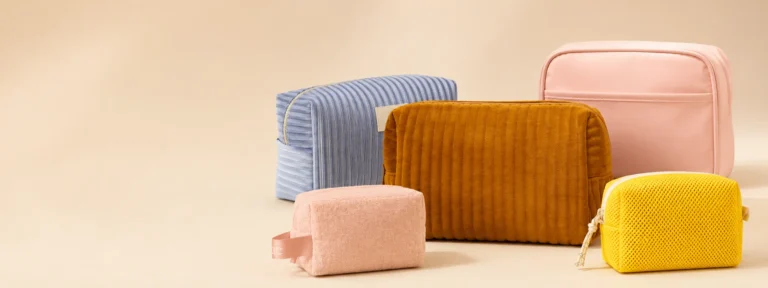
A custom cosmetic bag sample can hold a tall skincare bottle and still leave too little clearance for the zipper to close easily.That problem is easy to miss when development begins with a fabric swatch and a reference photo. The product load should guide the material, opening, support layers and interior layout. Sampling then has a clear purpose: to make sure those decisions work together before the buyer approves the production specification.
Pack the intended products before finalizing the bag size
During a sample review of a hanging toiletry organizer, a tall skincare bottle sat inside the main compartment, but its cap pressed against the top panel. Closing the zipper required pressure on the lid. After the bag was hung from a bathroom rail, a second problem appeared: the lid did not drop far enough, leaving the lower compartment difficult to reach.
The pattern correction followed those two faults. More internal height was left above the bottle. The U-shaped zipper continued farther down the side panels, and the connection between the lid and the bag body was adjusted so that the lid could move more freely when open.
The corrected sample still has to be checked with the bottle packed and the organizer hanging. Inspection on a table had not revealed either problem.
What to send for a pack-out check
Before the pattern is confirmed, provide the product set as it will be packed:
- Measure each item with its cap, pump or brush handle included.
- Show the full quantity that will be carried at one time.
- Mark any bottle that must remain upright.
- Add a layout photograph showing the position of the products. For a hanging organizer, include the bag in its open, hanging position.
If the products cannot be sent to the sample room, the dimensioned list and layout photograph become the working reference. Outside bag dimensions are not a measurement of usable capacity. Seam allowances, padding, support panels, lining and pockets all occupy space inside the finished bag.
Size approval should be based on the loaded sample: the zipper closes without pressure on the top panel, and the contents remain accessible in the position where the bag will be used.
Choose the construction from the access problem
Start with the item that is hardest to store or reach. Bottles that must remain upright create a different pattern problem from a group of compacts and long brushes. A bag that will hang open also needs a different opening from one used flat on a counter.
The first sample brief should select one construction route. Extra compartments can be added where the product load calls for them.
| Construction route | Suitable when | Check in the first sample |
| Structured makeup train case | The product set needs upright support, divided storage or brushes held inside the lid. | Open the double zip-around closure through its full path. Check divider positions against the packed products, and confirm that the base and side panels remain upright. If the lid has brush slots, the protective flap must cover the brush heads without interfering with the zipper or main compartment. |
| Clear cosmetic case | The user needs to identify the contents quickly and most products can share one open chamber. | Review the clear panels together with the binding and stitch lines. Check the reinforced handle and the top three-side zipper on the assembled case. Add elastic restraint only where small items would otherwise move around inside the main compartment. |
| Quilted cosmetic pouch | The product set is compact and the brief calls for a soft body with light cushioning. | Pack the pouch before approving the base width. Check how the quilting and filling behave near the zipper, especially where fullness gathers at the top. Internal pockets should stay simple unless the load plan shows a reason for additional separation. |
| Hanging toiletry organizer | Bottles and smaller items need to remain separated and accessible while the bag is suspended. | Test the reinforced hanging point, U-shaped zipper, side folds and lid angle with the organizer loaded. Bottle loops and mesh pockets should remain usable in the hanging position. If a separate wet-and-dry section is requested, its placement must not cover the compartments below it. |
Table: construction routes and first-sample checks. Compare the selected route against the intended product load.
Avoid combining every available function in the first drawing. A divider, lid pocket or separate internal section adds pattern pieces and attachment points. If it is introduced after the shell has been approved, the change may affect the panel dimensions or zipper path rather than remaining a simple pocket revision.
Before shell approval, mark the opening, dividers, pockets and support areas on a panel drawing. The drawing should also show whether the bag will be carried, opened flat or hung during use. After those points are fixed, the shell material can be specified together with its backing, padding, lining and trim.
Specify the material build, not only the face fabric
Place two PU makeup cases side by side and the outer surfaces may look quite similar. Pick them up, and the difference becomes easier to feel. One may stay soft. The other may keep its shape because the PU has been combined with backing, foam, support panels and lining.
Calling both of them “PU cosmetic bags” does not tell the sample room which result the buyer wants. The same problem appears with a request for a “polyester toiletry bag.” The material name gives a direction, but the rest of the build still has to be decided.
Start with the panels that need support
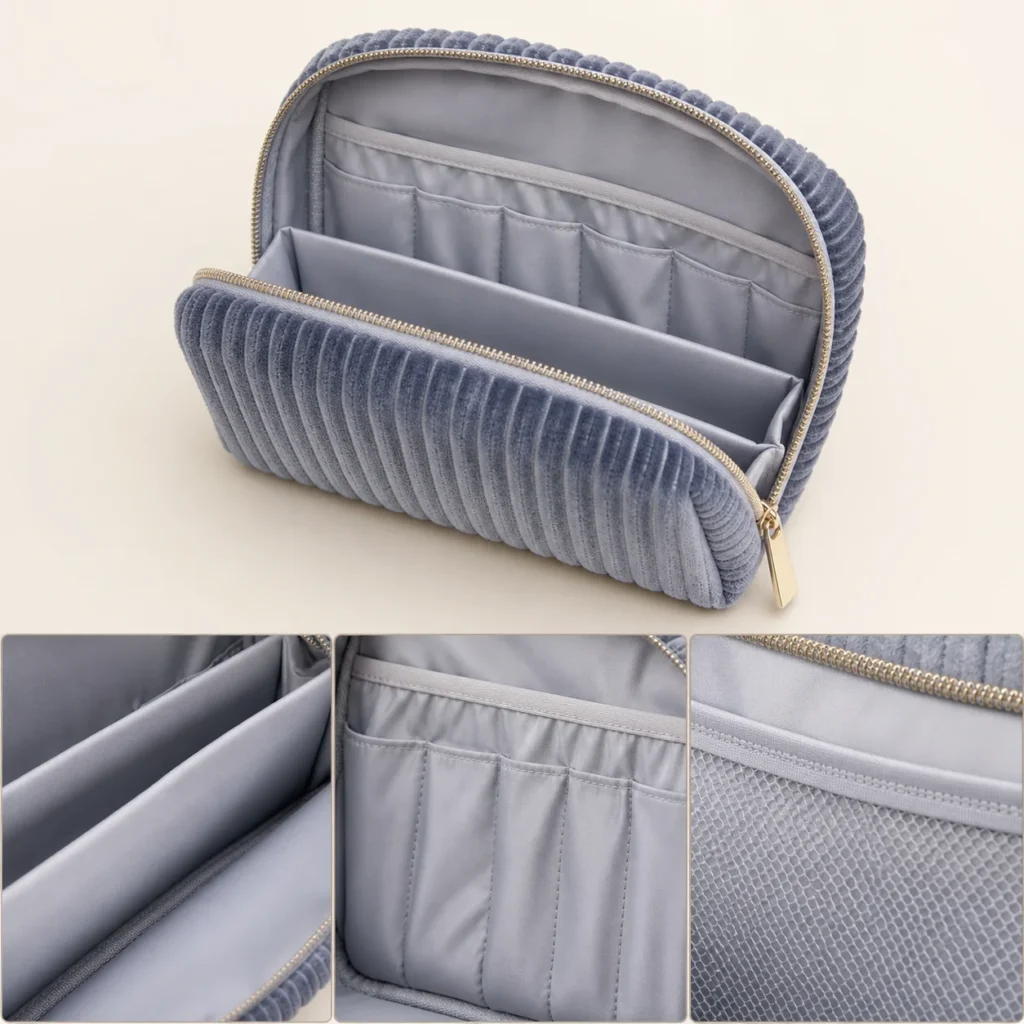
A structured train case normally needs more than the visible shell. PU leather or a heavier polyester can be used on the outside. Backing helps the surface stay stable during sewing, while foam adds cushioning. PE, PP or EVA support can be placed in the base and side panels that are meant to remain upright.
More support is not automatically better. Press the edge near the curved zipper and close the sample with the products inside. If that area has become too thick, the zipper may feel stiff around the turn and the material stack can take space from the main compartment.
A clear cosmetic case is another story. There is no lining to hide the inside of the binding or the panel joins. The clear panel, edge construction, reinforced handle and three-side zipper should be looked at together on the assembled sample.
TPU can be considered when that is the selected clear material. Its specification, order quantity and cost still need to be confirmed for the project. If the buyer asks for PVC, the required formulation and destination market should be clear before the material is ordered. The word “clear” alone does not settle either question.
For a quilted pouch, look at what sits between the face fabric and the lining. Nylon, polyester or corduroy can all be used on the outside, but the filling changes how full the surface looks and how the pouch bends. A fuller build also leaves less room around the zipper. Make the sample before deciding that more padding will give the better result.
A hanging organizer uses support in a different way. The body still needs to fold around the packed products, while the hook or handle area carries the hanging load. Reinforcement is more useful at those points than across every panel.
Choose the lining for what happens inside
Ordinary polyester lining gives the inside a textile surface. That may be suitable for many products, but it is not automatically easy to clean after lotion or liquid makeup enters the weave.
A coated polyester lining gives the buyer a smoother surface to check for wipe-clean use. Mesh makes sense for pockets where the contents need to remain visible and ventilated. These materials do different jobs, so there is no need to choose one lining for every section of the bag.
RPET lining can be considered when recycled material is already part of the order requirement. Check the available material, order quantity and any required GRS documentation before approval. “Eco-friendly lining” is not enough information for sourcing or for a compliance file.
Water resistance is a separate requirement
A treated outer fabric may be described as water-resistant when that wording matches the approved material. It does not make the complete sewn bag waterproof. Needle holes, zipper construction and panel joins still matter.
The same limit applies to other performance wording. Wipe-clean should describe the approved surface. Leak-resistant should only be used when the bag construction is intended to limit leakage and the test method has been agreed. Required material tests and compliance documents depend on the destination market, final material and testing route; the material name by itself does not establish the required report.
Specify the material build, not only the face fabric
Place two PU makeup cases side by side and the outer surfaces may look quite similar. Pick them up, and the difference becomes easier to feel. One may stay soft. The other may keep its shape because the PU has been combined with backing, foam, support panels and lining.
Calling both of them “PU cosmetic bags” does not tell the sample room which result the buyer wants. The same problem appears with a request for a “polyester toiletry bag.” The material name gives a direction, but the rest of the build still has to be decided.
Start with the panels that need support
A structured train case normally needs more than the visible shell. PU leather or a heavier polyester can be used on the outside. Backing helps the surface stay stable during sewing, while foam adds cushioning. PE, PP or EVA support can be placed in the base and side panels that are meant to remain upright.
More support is not automatically better. Press the edge near the curved zipper and close the sample with the products inside. If that area has become too thick, the zipper may feel stiff around the turn and the material stack can take space from the main compartment.
A clear cosmetic case is another story. There is no lining to hide the inside of the binding or the panel joins. The clear panel, edge construction, reinforced handle and three-side zipper should be looked at together on the assembled sample.
TPU can be considered when that is the selected clear material. Its specification, order quantity and cost still need to be confirmed for the project. If the buyer asks for PVC, the required formulation and destination market should be clear before the material is ordered. The word “clear” alone does not settle either question.
For a quilted pouch, look at what sits between the face fabric and the lining. Nylon, polyester or corduroy can all be used on the outside, but the filling changes how full the surface looks and how the pouch bends. A fuller build also leaves less room around the zipper. Make the sample before deciding that more padding will give the better result.
A hanging organizer uses support in a different way. The body still needs to fold around the packed products, while the hook or handle area carries the hanging load. Reinforcement is more useful at those points than across every panel.
Choose the lining for what happens inside
Ordinary polyester lining gives the inside a textile surface. That may be suitable for many products, but it is not automatically easy to clean after lotion or liquid makeup enters the weave.
A coated polyester lining gives the buyer a smoother surface to check for wipe-clean use. Mesh makes sense for pockets where the contents need to remain visible and ventilated. These materials do different jobs, so there is no need to choose one lining for every section of the bag.
RPET lining can be considered when recycled material is already part of the order requirement. Check the available material, order quantity and any required GRS documentation before approval. “Eco-friendly lining” is not enough information for sourcing or for a compliance file.
Water resistance is a separate requirement
A treated outer fabric may be described as water-resistant when that wording matches the approved material. It does not make the complete sewn bag waterproof. Needle holes, zipper construction and panel joins still matter.
The same limit applies to other performance wording. Wipe-clean should describe the approved surface. Leak-resistant should only be used when the bag construction is intended to limit leakage and the test method has been agreed. Required material tests and compliance documents depend on the destination market, final material and testing route; the material name by itself does not establish the required report.
Use the custom cosmetic bag sample to resolve cleaning, color and branding conflicts
A drawing can show five brush slots inside a train case. It cannot show where the remaining powder will go after the brushes are stored and the lid is closed.
In one sample, the brush heads were left exposed above the slots. Powder could reach the lining on the opposite side of the case. A clear TPU flap was added over the brushes, but adding the flap was only part of the correction. It still had to cover the brush heads, fasten in the right place and fold away without blocking the zipper or the main compartment.
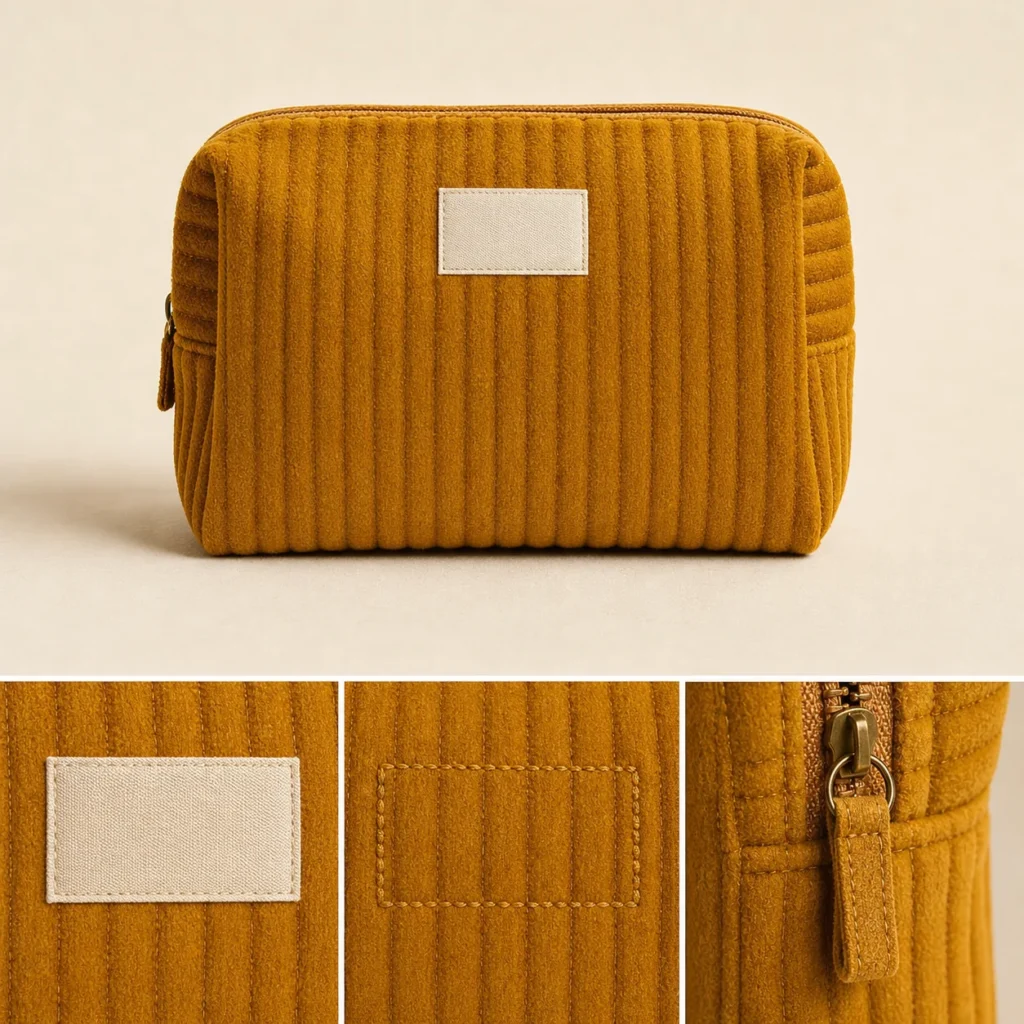
The same train case had a logo problem. The artwork was pressed into a deeply textured PU, and the fine edges lost clarity in the grain. Looking at the logo file on a screen would not have shown that result.
A metal badge or molded label can place the logo above the textured surface and may give the outline a cleaner appearance. That change also affects attachment, backing, tooling, quantity and cost. Put the proposed logo on the selected material and padded panel before approving the process.
Cleaning and color need a physical check too
Another sample used an ordinary woven polyester lining for an interior that was meant to be easy to maintain. Lotion entered the weave during review and left a darker mark. The next sample used a matte coated polyester lining that was easier to wipe.
That material change solved one problem and exposed another. The coated lining and the PU shell were based on related color references, but they did not look the same under the agreed viewing light. Fabric, coating, zipper tape, thread, PU and metal hardware all reflect light differently.
Lab dips and component samples are useful before assembly. They still do not replace the finished bag. Put the components together and look at the color relationship again. A Pantone reference gives the project a color target; it does not make unlike surfaces appear identical.
Use the sample the way the customer will
Pack the approved products in their normal position. Close the zipper without forcing the contents into a new arrangement. If the bag is meant to hang, open it from the hook and remove the products from the upper and lower sections.
Now check the details that depend on touch and use. Wipe the approved lining with the agreed cleaning method. Look at the logo from a normal viewing distance, not only close up. Compare the lining, zipper, thread, outer material and hardware under the agreed light.
A drawing can locate these parts. The sample shows what happens when they are used together.
Record the approved build for production and repeat orders
The information needed to start a sample is not the same as the information that should be recorded after approval.
Before the first sample
Start with the intended products and the position in which the bag will be used. Add a reference image, approximate dimensions and the selected construction route. Any divider, brush panel, hanging section or other function that changes the pattern should be included at this point.
If the logo belongs on the first sample, send the artwork with the preferred size and position. The destination market should also be stated before materials are ordered when a material test or compliance document will be required.
You do not need to decide every hidden layer before asking for a feasibility review. You do need to explain what the finished bag is expected to carry, how it should open and which details are important to keep from the reference.
After the sample review
Comments should identify the item, location and fault. “The tallest bottle presses against the top zipper” gives the pattern maker a specific problem to correct. “Make the bag bigger” does not show whether the issue comes from height, padding, pocket position or the zipper opening.
Use marked photographs and measurements where they make the change clearer. When a new drawing is issued, keep it with the correct sample version.
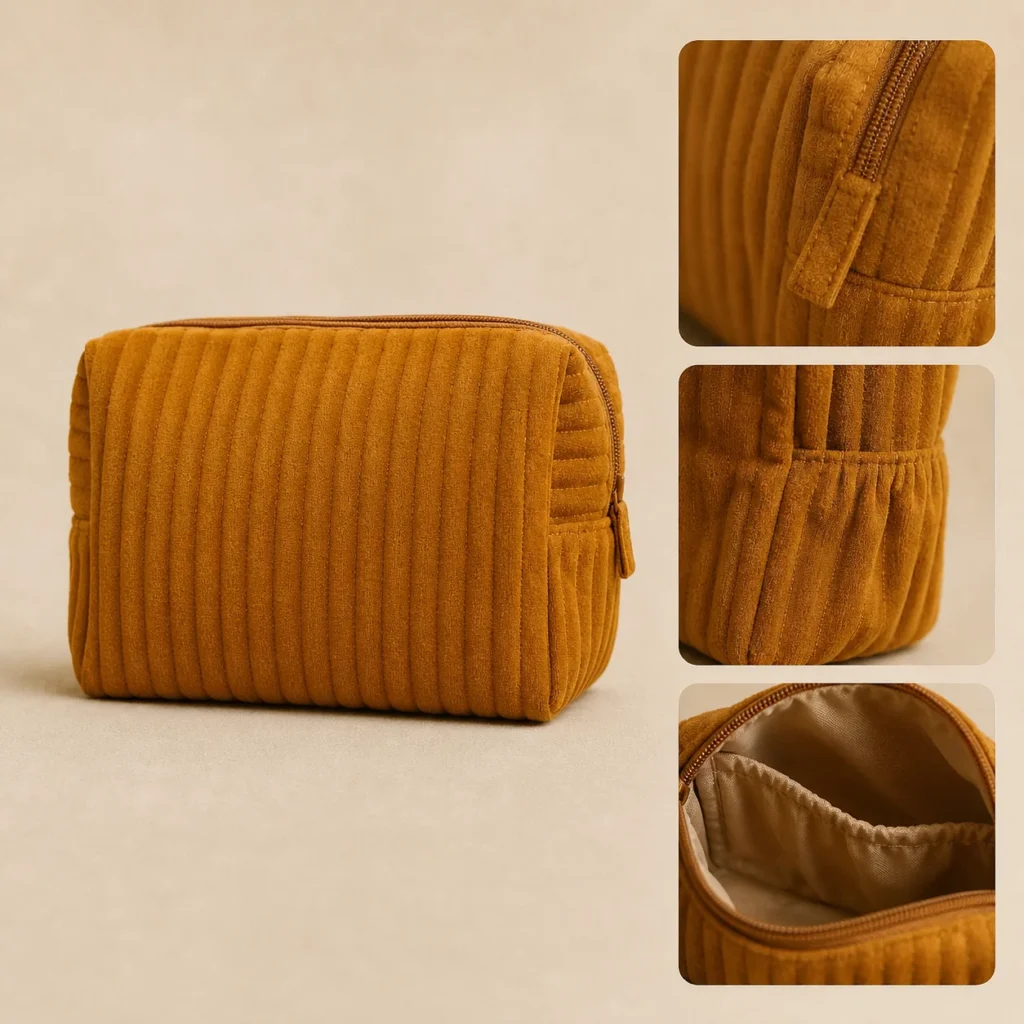
After approval, the physical sample and the written specification should describe the same bag. Record the outer material, backing or support, lining, binding, zipper, hardware, colors, internal layout and logo process. Keep any approved performance wording with that version as well.
A later change to the lining, zipper path or compartment layout creates a different build. It should be reviewed before the next production run rather than carried forward as an informal note. This becomes especially important for repeat orders, where the approved version has to be clear without relying on memory.
Frequently Asked Questions About Cosmetic Bag Materials and Structure
What Is the Best Material for a Cosmetic Bag?
There is no single best material for every cosmetic bag. PU can suit a case where the surface finish and shaped body are part of the design. Nylon or polyester may work better for a softer fabric bag, while clear TPU can be considered for a transparent case.
The outer material is only one part of the bag. Backing, padding, support panels, lining and the zipper construction also change how the finished sample looks, bends and holds its shape.
Are Cosmetic Bags Waterproof?
Not automatically. A water-resistant outer fabric or a wipe-clean lining does not make the complete sewn bag waterproof. Water can still pass through needle holes, zipper areas and panel joins.
If protection from spills is important, describe where the liquid is likely to come from and what the bag is expected to do. The selected material and construction can then be checked together on the sample. Leak-resistant wording needs a suitable construction and an agreed test; it should not be assumed from the fabric name.
Is a Structured Makeup Case Better Than a Soft Pouch?
It depends on what will be stored inside. A structured case makes sense when bottles need upright support, dividers must stay in position, or brushes are carried inside the lid. A soft quilted pouch may suit a smaller product set that needs a flexible body and light cushioning.
The extra support in a structured case also occupies space. If too much padding or panel support is placed near a curved zipper, the case may become harder to close. Both options should be judged with the intended products inside.
How Do I Know What Size Cosmetic Bag I Need?
Start with the products rather than a small, medium or large size label. Include the cap or pump when measuring a bottle, and check the full length of brushes and the width of larger compacts. The quantity carried at one time matters too.
Then load the sample. The zipper should close without pressing the tallest item into the top panel, and the products should remain easy to reach when the bag is used normally. For a hanging organizer, that check needs to be made while the bag is hanging open, not only while it is lying on a table.
What Makes a Cosmetic Bag Easier to Clean?
The lining surface matters, but so does access to the inside of the bag. An ordinary woven polyester lining can hold lotion or liquid makeup in the fabric texture. A coated polyester lining gives a smoother surface that can be checked for wipe-clean use.
The opening should also leave enough room to reach the corners and seams. Before approval, wipe the selected lining with the cleaning method planned for the product. A material described as wipe-clean still needs to be checked on the assembled sample.
If you already have the product set, a reference photo or an existing custom cosmetic bag sample, you do not need to know every material detail before starting.Send Annabelle Bag the intended contents or dimensions, reference, estimated quantity, logo artwork and destination market. These details give the development team a practical starting point for a quotation or sample feasibility review.