
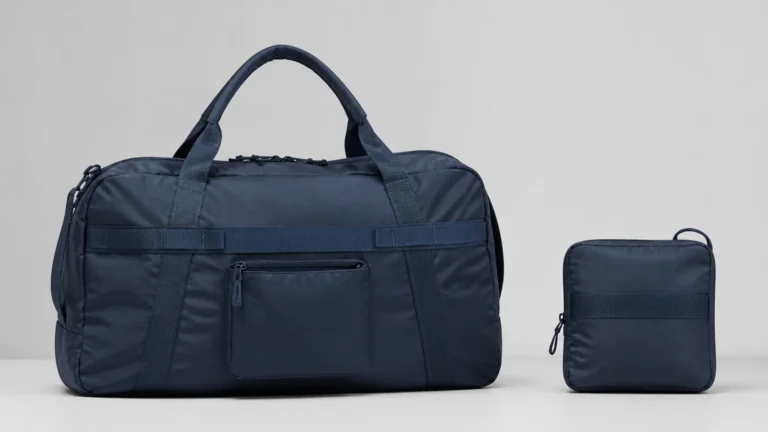
A travel bag may hold everything on the packing list and still fail its fold test. Once the handles, zipper tape, seams and pockets are pushed into a self-stow pocket, the packed bundle can be larger than the pattern allowed. A foldable travel bag therefore needs two working specifications: one for carrying and one for storage. This article explains how to align those sizes with the packaway structure, material build and sample checks before a sample is approved.
Check the Bag at Full Size and Packed Size
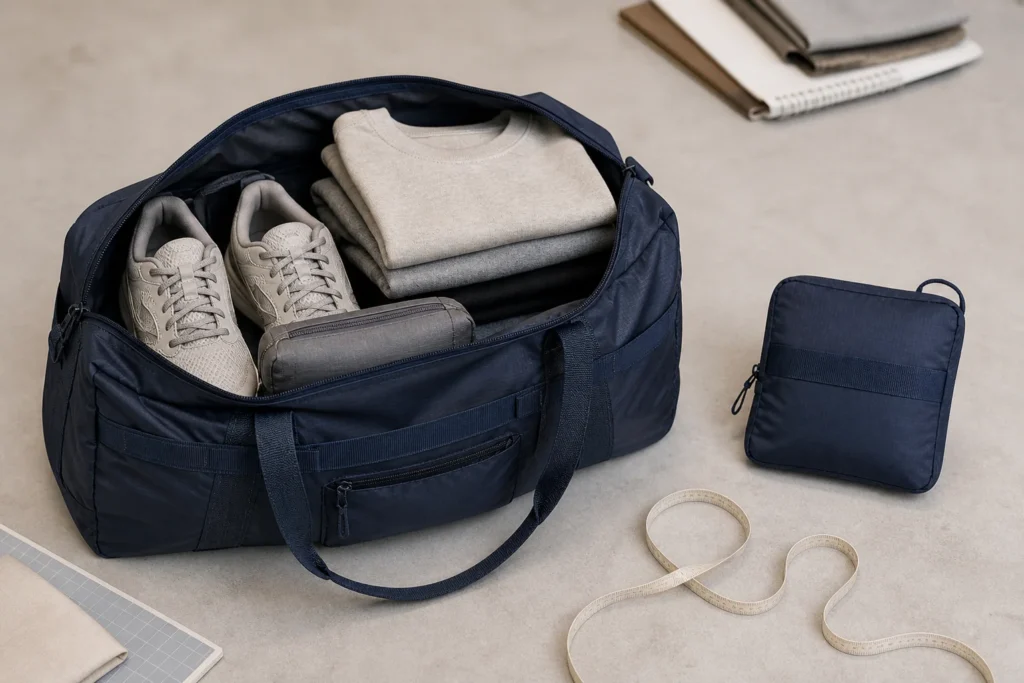
Put the intended load into the first sample before deciding that its capacity is right. Shoes are useful here because they do not compress like clothing. A toiletry bag or packing cube can expose the same problem: the volume may be available, but the opening is too short, or one rigid item pushes into the top zipper.
The capacity figure still belongs in the specification, but it is not the only size check. We also look at the longest item, the depth of the gusset and the space taken by any separate shoe compartment. Then the bag is closed and lifted by its handles. If the top panel has to be pressed down to move the zipper, the sample does not yet have usable capacity at the stated load. The body size, opening or compartment layout needs another look.
Now empty the sample and fold it in the intended order. The packed size should be measured only after the zipper or retaining strap is closed. A flat pattern measurement will miss the thickness added by bound seams, zipper tape, handles and reinforcement. These parts do not disappear when the shell is folded.
Watch the last few centimeters of the closure. If one corner must be pushed down while the zipper is pulled with the other hand, the storage pocket is already too tight for normal use. Fabric caught beside the slider is another warning. Record the closed length, width and thickness, along with anything that made packing awkward. A slightly larger pocket or a different fold may solve the problem without changing the open capacity of the bag.
Choose the packaway structure before the pocket is patterned
Turn the Pocket Out Before Approving It
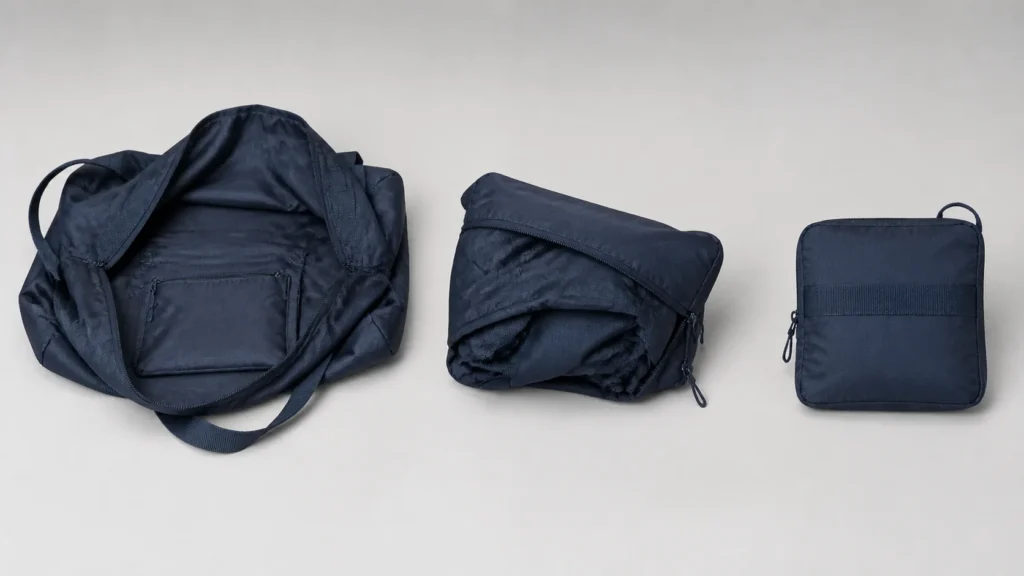
On a self-stowing sample, we open the storage pocket and turn it out before judging whether it is large enough. The zipper pull must still be reachable from the outside. With one hand on the pull tab, we follow the intended fold order and guide the handles and body through the opening. If the bag stops at the handle base, we open it again and look at the webbing and seam layers in that spot.
After unpacking the bag, we turn the pocket back and check it again. It should return to its normal position, close cleanly and remain usable as an ordinary pocket when the bag is open.
Check Where the Separate Pouch Sits
With a separate stuff sack, the main bag stays the right way out. We fold the duffel, place it in the pouch and close the drawcord or zipper without twisting the handles into a hard knot. Then we open the duffel again and check where the empty pouch sits.
If it is meant to stay with the bag, the small pouch can be clipped to an inner webbing loop. It should not hang across the main zipper or catch on the packed contents. Some buyers may prefer it removable. Confirm that choice on the sample. A loose pouch is easy to leave behind.
Let the side panels guide a flat fold
A flat-fold bag does not pass through a pocket opening. The body collapses along the side gussets and base until it becomes a thin layer for storage or shipping. This route works only when the construction has somewhere to bend. A fixed board, a stiff corner or several layers of binding in the same spot can leave one end much thicker than the other.
Lay the sample down and follow the folds that the sewn panels make naturally. If the gussets turn in different directions each time, the stored shape will be inconsistent. A removable base insert can give the open bag a flatter loading surface, but its removal and storage need to be included in the product instructions and sample review. Hiding a rigid board inside the base defeats the flat-fold requirement.
Set the roll before locating the securing strap
Roll-up storage suits a soft body that can bend repeatedly without a hard panel interrupting the roll. The starting edge matters. Handles, zipper ends and pocket corners move toward the center as the body is rolled, so their combined thickness determines the final diameter.
The elastic loop, snap strap or buckle strap should be positioned from that finished roll, not from an empty flat pattern. If the strap barely reaches on the first sample, a user will pull against the attachment stitching every time the bag is stored. A longer strap may help, although a smaller roll may also be possible after the fold order is changed.
External bungee cord and side compression straps have a different job. They can control loose fabric, reduce movement in a partly filled bag or hold a folded body in place. They do not turn a travel bag into a self-stowing design. The RFQ still needs to name the primary route: pocket, pouch, flat fold or roll-up.
Build the material stack around the fold line
Choose the shell after the packed target is known
Low folded bulk may lead the sample team toward 70D or 210D nylon ripstop. These fabrics can provide a flexible, lightweight shell, but the fabric name does not settle the complete construction. The weave, finish, coating, seam treatment and reinforcement still affect how the finished bag folds and how it behaves when loaded.
For a cost-controlled retail or promotional direction, 190T or 210D polyester ripstop may also be considered. Polyester can offer useful dimensional stability and a practical surface for color or print development. A more substantial packable duffel may use a selected 420D nylon or polyester route. In that case, the packed target has to allow for the extra body of the fabric and the chosen backing.
The denier number cannot be used as a load rating. Two fabrics carrying the same denier description may differ in weave, finished weight, coating and hand. Put the candidate swatches beside the reference bag, then sew the selected route into the sample. That is where the buyer can judge whether the body is too limp, too stiff or simply too bulky for the intended fold.
PU coating, silicone finish, TPU lamination and DWR are separate material choices. They should be selected for the order rather than treated as interchangeable versions of “waterproof fabric.” A water-resistant shell can help with light exposure to moisture, but ordinary sewn seams and zippers still prevent an automatic waterproof claim for the completed bag.
Keep the inside lighter than the outside
An ultralight bag may have no full lining. Bound internal seams can cover the raw edges without adding a second layer across the whole body. Where organization is needed, a partial lining can be limited to a pocket or a separate compartment.
The packed bundle becomes noticeably thicker when a full lining, several overlapping pockets and reinforcement all fold into the same area. Padding creates the same problem if it continues across a hinge or gathers beside the storage pocket. Local padding at a handle or strap can still be considered, provided the sample shows that it bends where the folding sequence requires it to bend.
Treat the base insert as a separate component
A small stored shape usually leaves little room for a permanently sewn rigid base. If the bag needs a flatter loading surface when open, a removable insert may be a better route. The buyer then needs to decide whether the insert travels inside the folded package, is stored separately or is omitted from the packaway configuration.
Heavy PVC backing, rigid PU and other stiff builds can create bulk or leave visible marks where the fabric is repeatedly folded. The material name alone cannot predict how noticeable those marks will be. The agreed sample cycle should use the selected material, coating and color because a substitute swatch may recover differently.
Keep the load path out of the packaway bottleneck
Carry webbing can solve one problem and create another. Running the handles under the base may distribute the intended load, yet the same continuous webbing can cross the area that has to turn through a self-stow pocket. Where the webbing meets a bound seam or reinforcement patch, the stack becomes harder to bend.
Trace the handle route on the sewn sample, including every turned end and bar tack. Then fold the bag in the approved order. If the thickest junction arrives at the narrowest part of the pocket, changing the outer fabric will not remove the blockage. The webbing route, overlap or pocket position needs to change while the agreed carry requirement remains in view.
The pocket itself has to be patterned around the assembled bag. Shell area is not a useful shortcut because zipper tape, seam allowances, binding, handles, pockets and reinforcement all occupy space after folding. A shallow flat pocket may look neat when empty and still be unusable once the duffel is pushed inside. Adding controlled depth with a gusset gives that thickness somewhere to go.
Zipper access belongs in the same review. A one-sided slider may disappear inside the reversed pocket, leaving the user unable to close it from the outside. A reversible slider or another approved two-sided arrangement can prevent that failure. The pull tab, stops and pocket corners must remain reachable after inversion, while backing patches and bar tacks protect the ends without building another hard obstruction beside the zipper turn.
Anonymous case: a 35L packable duffel that could not fit its own pocket
Why the first sample stopped at the pocket
One anonymous project began with a 35L packable duffel. The open bag had to carry the customer’s intended weekend or gym load, and the stored package was required to stay within 18 × 14 cm. The handle construction also had an agreed 10kg load condition for that project.
The first sample worked as a duffel, but packing it exposed three faults. Multi-layer seams accumulated around the self-stow pocket, leaving too little room for the folded body. Thick continuous handle webbing crossed the same area and resisted the turn as the bag was pushed inside. Once the pocket had been reversed, the one-sided zipper slider was no longer accessible from the outside.
More force did not make the sample acceptable. Pulling harder loaded the zipper teeth and drew loose fabric toward the slider. The packed bundle also depended on who folded it and how firmly the corners were compressed. That was not a repeatable storage state for the approved specification.
How the revised pattern made room
The pocket length and width were each increased by 1.5cm. A 2cm gusset was added around the pocket so that seam accumulation and folded thickness could sit inside the package instead of pressing directly against a flat panel.
The handle route changed as well. A softer high-density twill webbing was used, and its position was adjusted to avoid the worst overlap near the pocket opening. The zipper was changed to a reversible slider, with a pull tab placed where the user could control the pocket during inversion.
The revised sample was packed and reopened through 100 fold-and-zip cycles. It was also reviewed under the agreed 10kg load condition. Those figures belonged to this project and its sample specification; they are not general requirements for every foldable travel bag. After the checks were completed, the anonymous customer approved the revised construction and the project moved into production.
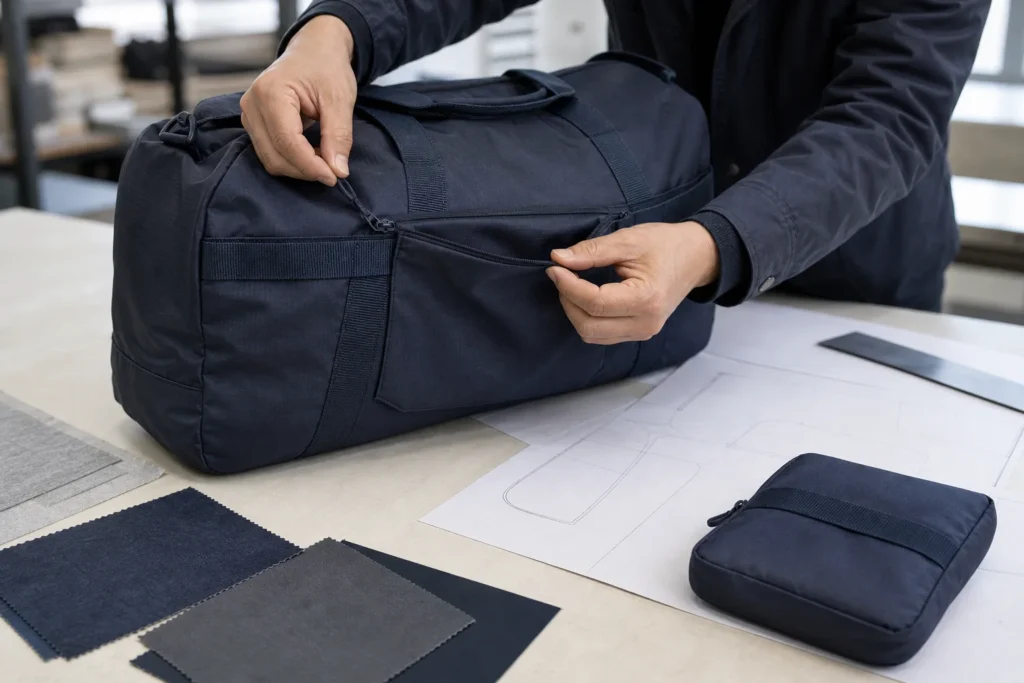
Editorial illustration only; it does not document the anonymous customer’s actual sample.
Check the packed bag and the loaded bag as two sample states
Run the packaway sequence as a user would
The packing check begins with the agreed fold order. One person should be able to locate the storage pocket or strap, control the corners and close the package without forcing the zipper. During that sequence, record any place where fabric enters the slider, the zipper teeth spread, the coating whitens sharply or a pull tab becomes inaccessible.
Measure the package only after it is fully closed. Length and width alone may hide a thick corner, so include the approximate thickness and note whether the bundle sits flat. If the packaway route uses a separate pouch, confirm where the empty pouch stays when the travel bag is open. For a flat fold or roll-up design, check whether the panels return to the same stored shape each time.
Open the same sample and load it again
Unpack the bag and allow the body to return to shape. Look at the fold lines, coating and corners before adding the intended contents. Persistent whitening, delamination or a crease that blocks the zipper needs to be recorded against the selected material build rather than dismissed as a temporary packing mark.
The loaded review has a different purpose. Pack the agreed contents, close the main zipper and lift the bag by the intended handles or straps. Check the base shape, handle position, seam stress and reinforcement under the load condition set for that order. Do not borrow the 10kg figure from the anonymous case unless the new project’s specification independently requires it.
If a self-stow pocket also works as an ordinary pocket, use it in that open state. The zipper should run normally, and the reversed construction should not leave loose binding or hardware where it can catch the contents.
Keep the approved construction in the sample record
A passed sample is difficult to reproduce if the record says only “folding test approved.” Retain the pocket dimensions, gusset, zipper direction, webbing route, reinforcement positions, material code, coating and folding sequence. Photographs of the open, folded and packed states can support those written details.
Any repeated-fold or zipper-cycle requirement should be written for the order with its acceptance criteria. The same applies to the load condition and the way it is applied. General AQL inspection can support shipment quality control, but it does not prove folding life, zipper life, load capacity or waterproof performance.
What to put in the RFQ before sampling begins
A quote-ready foldable travel bag brief should describe both versions of the product. Include:
- The intended use and the contents the open bag is expected to carry.
- Expanded dimensions or capacity, along with the opening needed for the longest or least flexible item.
- Target packed length, width, approximate thickness and preferred stored shape.
- The primary packaway route: self-stow pocket, separate pouch, flat fold or roll-up.
- Any external compression cord or strap, listed separately from the packaway route.
- The preferred shell material, hand, finish, coating and color direction. Send an approved reference bag or swatch when the material name is unknown.
- Lining, pockets, padding, removable base support and other organization requirements.
- The intended load, handle or strap arrangement and the agreed method for checking that load.
- Logo method and position, estimated order quantity, color split, target market and any order-specific material or test documents.
This information gives the material supplier, pattern team and sample room the same target. It also shows where a decision is still open. A buyer may know the packed dimensions but need help comparing nylon and polyester routes, or may have an approved shell but no workable pocket construction. Those are useful starting points. “Lightweight foldable duffel” by itself leaves the size, storage method and sample checks undefined.
Frequently Asked Questions About Foldable Travel Bags
Can a foldable duffel bag be used as a carry-on or personal item?
It can, provided the loaded bag stays within the operating airline’s limits. The small size of the folded package does not determine whether the bag qualifies. Airlines assess the bag in use, so measure it after packing at its widest points, including the handles and any pockets that bulge outward.
A personal item normally has to fit under the seat, while a carry-on may be stored in the overhead compartment. The limits are not universal. IATA notes that baggage allowances and conditions remain airline specific and may also vary by cabin class and aircraft type. Check the operating carrier before the trip, especially on an itinerary that includes a partner airline or a smaller aircraft. For a custom cabin-use bag, set the expanded target from the intended airline rules and review the loaded sample against that target.
Are foldable, packable, and collapsible travel bags the same?
The words overlap, and product listings do not use them consistently. A foldable bag may fold flat or roll up. Packable often describes a bag that goes into its own pocket or a separate pouch. Collapsible can refer to a bag that loses its box shape for storage, even if it does not form a closed package. For product development, the label is less useful than the storage instruction. State whether the bag must pack into a self-stow pocket, fit inside a separate pouch, fold flat, or roll under a retaining strap. Add the required packed length, width, and thickness. That information gives the pattern maker a defined result to build and check.
Can a foldable travel bag include a separate shoe compartment?
Yes, although the compartment changes both versions of the bag. When open, the shoe section takes space from the main compartment unless extra body volume is added. When folded, its zipper, divider, lining, ventilation panel, and bound seams stay inside the package. Shoes are also less compressible than clothing.
The first sample should be packed with the intended footwear, then emptied and folded in the agreed sequence. Check the remaining main-compartment capacity and the thickness of the closed package. A tight packed-size target may require fewer overlapping layers, a softer divider, or a different position for the shoe section. It should not be assumed that a divided bag will pack as small as a single-compartment version.
Is a self-stow pocket better than a separate storage pouch?
Neither option is better for every bag. A self-stow pocket stays attached to the product, so there is no loose pouch to misplace. It also has to turn inside out and hold the full folded body. Pocket depth, seam bulk, zipper direction, and the route of the handles all become part of the main pattern.
A separate pouch leaves the travel bag facing the same way during packing and can keep the main pattern simpler. The pouch still needs a place when the bag is open. It may be removable, clipped to an inner loop, or stored in a pocket, depending on the project. Choose the route from the required stored shape and the way the user is expected to pack and reopen the bag. Then test that complete sequence on the sewn sample.
Are foldable travel bags waterproof?
Some are made for waterproof use, but foldability alone says nothing about water protection. Many lightweight travel bags use a coated fabric or a water-repellent surface treatment that can handle splashes or light rain. On a conventional cut-and-sewn bag, water can still enter through needle holes, bound seams, or an ordinary zipper. A waterproof fabric is therefore only one part of the finished construction. If the bag needs stronger protection, define the expected exposure before selecting the fabric, seams, and closure. The whole bag should be called waterproof only when its construction and project-specific test evidence support that claim. Otherwise, use the water-resistance description that matches the approved material and sample.
Can a foldable duffel bag be washed in a washing machine?
Only if the care label or product instructions allow it. The shell fabric may tolerate water while other parts do not. Machine agitation, detergent, or heat can damage a coating, printed logo, foam layer, base insert, lining, or metal hardware. A folded bag can also trap detergent inside pockets and bound seams.
Empty every compartment and remove any detachable base insert before cleaning. Follow the stated washing and drying method for that product. If machine washing is not listed, use the specified hand-cleaning or spot-cleaning method instead. For a custom order, confirm the care method on the selected materials and the finished sample before approving the sewn-in label.
Define both states before requesting the sample
Send the expanded dimensions or capacity, target packed size, chosen packaway method, intended contents and load, material direction or reference sample, order quantity, color plan and any required checks. Annabelle Bag can then review whether the pocket, zipper, webbing, reinforcement and material build belong to a workable first-sample route. If part of the design is still open, identify the feature that must remain unchanged and the tradeoffs that may be adjusted. A clearer two-state brief makes the quotation easier to interpret and gives the sample review a specific result to confirm.