
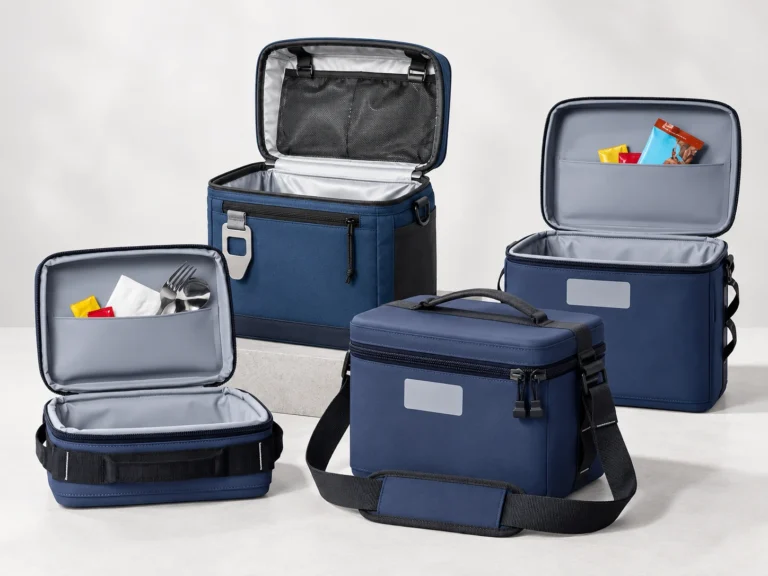
Promotional cooler bags often look straightforward until a project moves from a catalog image to an actual quotation. A different size, thicker insulation, extra pocket, shoulder strap or more complex logo can change the cost and the way the bag needs to be made. For buyers, the difficult part is not adding features. It is deciding which ones the promotion actually needs.
This guide explains what to define before sampling and bulk production, so the bag, branding, packing and target cost are working toward the same project.
Start With the Promotional Program, Not the Bag
A common way to start a cooler bag project is to find a product photo, add a logo and ask several suppliers for prices.
That can work when the intention is simply to buy an existing stock style. It becomes less reliable when the bag needs to be adjusted for a specific campaign.
Before deciding whether the product should be a compact lunch cooler, a box-shaped bag or a larger soft cooler, first define what the promotion is expected to do.
Who Will Receive the Bag?
A cooler bag given away at a one-day event does not need to follow the same specification as a corporate gift intended to be used repeatedly.
For an event giveaway, the priorities may be a visible logo, useful capacity and straightforward construction that stays within the project budget.
A corporate gift may justify more attention to the handle, shape, internal finish or packaging because the product itself carries more of the brand experience.
Supermarket and beverage campaigns bring different requirements again. The product may need to work with store distribution, carton quantities, barcodes or a particular pack-out arrangement.
The recipient does not determine every technical detail, but it gives the development team a much clearer starting point.
Think About How the Bags Will Be Distributed
Distribution is easy to leave until the end of development, even though it can affect packing requirements from the beginning.
If thousands of bags are being shipped to different stores, carton size and color allocation can matter much more than they would for one corporate-gift shipment.
An event organizer may want each bag individually packed and ready to hand out. A retailer may need a hangtag, barcode or other information attached before the goods reach the warehouse.
These requirements may not change the basic cooler structure, but they change what should be included in the quotation and production specification.
Set the Cost Direction Before Adding Features
Promotional projects usually have a target cost, even when the exact material and construction have not yet been decided.
It is more practical to treat that target as part of product development instead of designing a detailed bag first and trying to reduce the cost later.
If a simple cooler already meets the campaign’s capacity and branding needs, extra pockets, hardware or structural layers may add cost without adding much value.
For another project, a stronger handle, more defined body or better-finished branding may be exactly where the budget should go.
The objective is not always to make the simplest possible bag. It is to spend the available product budget on the details the promotional program will actually use.
Promotional Cooler Bag Specification Matrix
The table below gives a starting direction for several common promotional programs. These are development directions rather than fixed specifications. The final construction still depends on the intended contents, target cost, distribution plan and approved sample.
| Promotional Program | Structure Direction | Insulation Direction | Branding Priority | Packing Priority |
| Event giveaway | Simple, lightweight construction | Practical basic insulation | Large, visible logo | Simple individual packing |
| Corporate gift | More finished or structured body | Moderate, use-driven insulation | Cleaner branding finish | Presentation may matter more |
| Supermarket campaign | Cost-controlled and reusable | Practical insulation | Clear brand visibility | Barcode and carton planning |
| Beverage / food promotion | Capacity-focused structure | Based on intended contents | High logo visibility | Efficient campaign distribution |
| Outdoor / resort program | Stronger carrying structure | Based on expected use | Print, label or patch options | Retail or campaign-ready packing |
Once the program direction is clear, buyers can compare available custom cooler and lunch bag styles without treating every style as equally suitable for the project.
Choose a Cooler Bag Structure That Fits the Program
There is no single cooler structure that works best for every promotional order.
The useful starting point is to choose a body format that handles the required contents without introducing unnecessary construction.
Compact Lunch Cooler
A compact lunch-style cooler can work well for staff programs, school-related promotions, smaller giveaways and campaigns where the bag only needs to hold a modest amount of food or drinks.
The construction can remain relatively simple: one insulated main compartment, a zipper closure and a carrying handle may already be enough to create a practical product.
That simplicity can also leave a clear front panel for branding and help control manufacturing and packing complexity.
The important question is whether the internal space remains useful after the lining and insulation layers are added. Small outside dimensions do not always translate into equally useful internal capacity.
Box-Shaped Cooler Bag
A box-shaped cooler creates a more defined internal space and can work when the campaign requires a particular capacity or a bag that keeps a clearer shape.
This construction may use more support around the base or side panels and may require a wider opening than a simple lunch pouch.
During development, check whether the opening provides enough access, whether the bag remains stable when loaded and whether the handle positions make sense for the expected weight.
A more structured body can look substantial, but it can also require more internal support and occupy more shipping volume than a softer construction.
Collapsible Cooler Bag
A collapsible cooler can be useful when storage and distribution volume matter.
The benefit is not simply that the bag can be folded. The entire construction needs to tolerate that folding process.
Foam, lining, zipper tape, bottom support and side panels should still return to a usable shape when the bag is opened again.
For a high-volume promotional project, this can help with storage and distribution. It can also fail if too much internal support is added and the product no longer collapses cleanly.
That behavior is better checked on a physical sample than assumed from a drawing.
Medium or Outdoor Soft Cooler
A medium soft cooler is a more suitable starting point when the campaign needs more capacity, stronger handles, a shoulder strap or additional storage.
These designs can be developed for outdoor events, resorts, beverage promotions, supermarket programs and similar applications.
A larger cooler does not automatically need to become complicated.
One insulated main compartment, reinforced handles and a simple side or front pocket may already cover the intended use.
As the expected load increases, handle attachment, strap reinforcement and bottom support become more important during sample review.
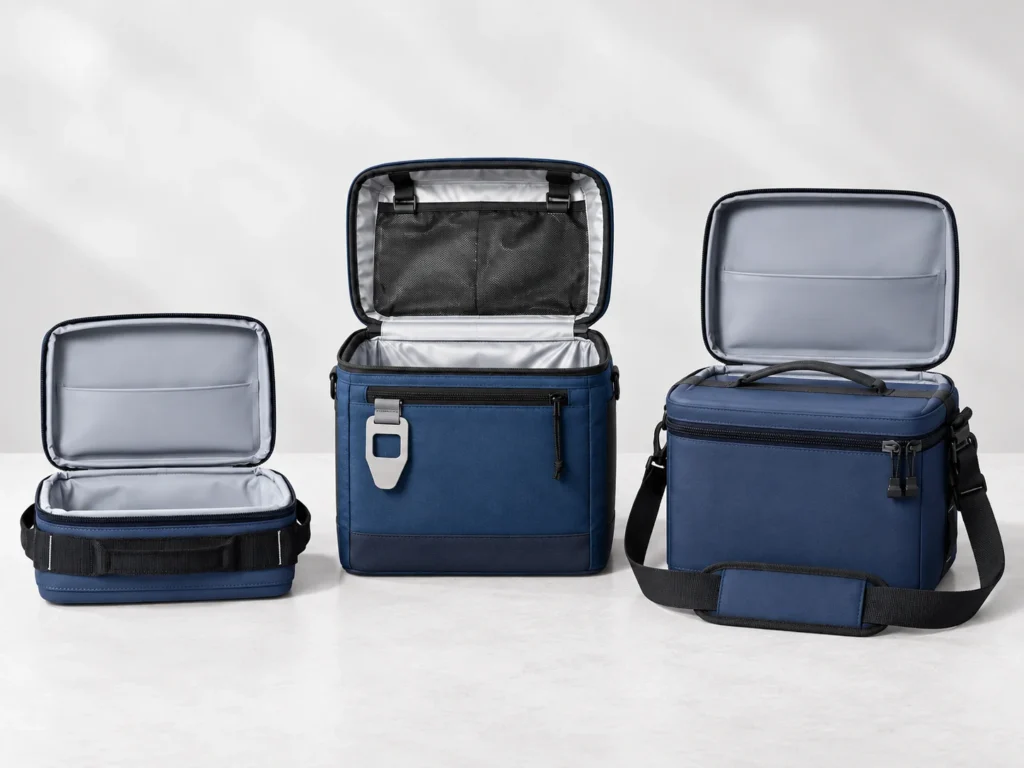
Specify the Insulation Around the Actual Use
For a promotional cooler bag, more insulation is not automatically a better specification.
A bag made for a short promotional event has a different job from one intended for repeated outdoor or grocery use. Before increasing foam thickness or changing the lining, first define what the bag is expected to carry and how it will normally be used.
The insulated body can then be developed around that requirement.
Outer Fabric Is Only the First Layer
Polyester, Oxford fabric and nylon are common directions for soft cooler bags.
The choice affects the appearance and feel of the product, but it can also influence the body structure, branding surface and target cost.
For a straightforward promotional program, a practical polyester or Oxford construction may be sufficient. If the bag needs a firmer body or is expected to carry more weight, the material and supporting structure may need to change.
The outer material should not be evaluated only as a fabric swatch. It will behave differently once combined with foam, lining, seams and the finished bag shape.
Foam Changes More Than Insulation
The foam layer sits between the outer shell and inner lining and helps form the insulated body.
Changing it can also affect wall thickness, flexibility, internal capacity and carton volume.
That matters on cost-controlled promotional projects.
Increasing the insulation layer may sound like a simple upgrade, but buyers should consider whether the additional bulk provides meaningful value for the actual application.
There is no single foam thickness that should automatically be used for every promotional cooler. The construction should be evaluated together with the bag size and intended use.
Choose the Inner Lining for the Finished Product
PEVA and aluminum-foil-style linings are common options in soft cooler construction.
The decision should consider the intended contents, cleaning requirements, body construction and target cost rather than appearance alone.
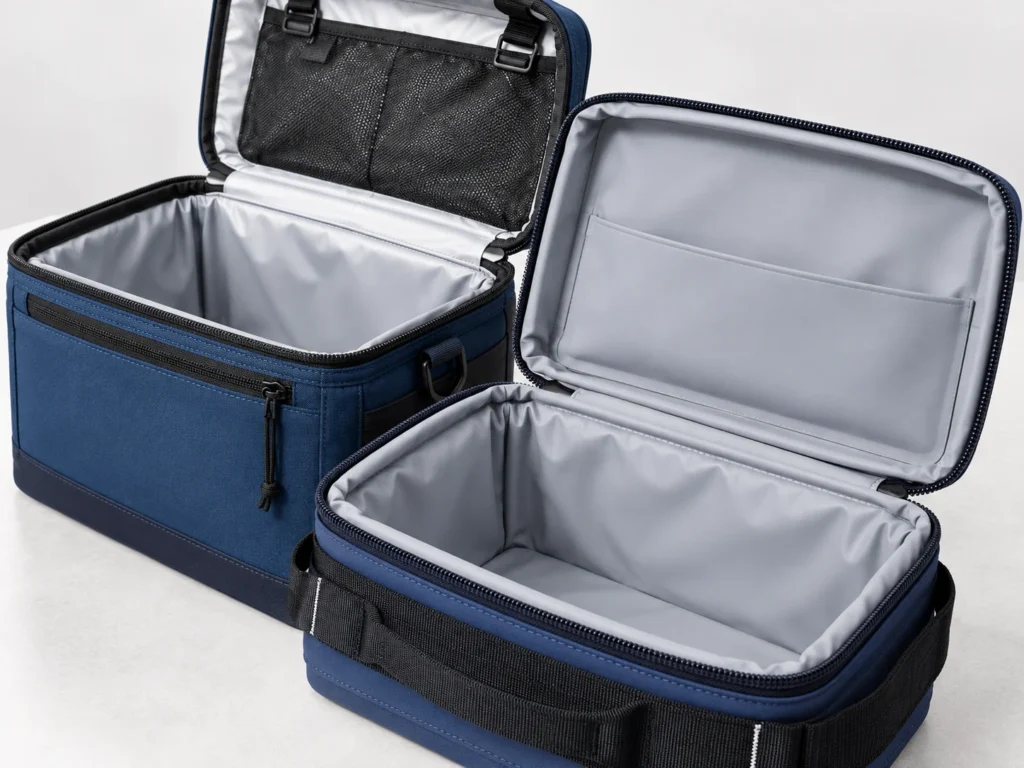
The lining also needs to fit correctly with the surrounding insulation and pattern.
Corners, seams and the area around the opening are worth checking on the sample. A lining material may appear suitable before assembly but still wrinkle, pull or fit poorly if the internal construction has not been developed correctly.
Do Not Ignore the Opening
Insulation does not end at the side walls.
A wide opening can make loading easier, while the zipper, lid and closure structure determine how the top of the insulated compartment comes together.
It is therefore more useful to review the cooler as one system:
outer shell → insulation layer → lining → opening → closure
rather than judging performance from one material specification.
Do Not Add Features the Promotion Does Not Need
It is easy for a simple promotional cooler bag to become expensive one decision at a time.
Add a front pocket. Then a shoulder strap. Then stronger hardware. Then another compartment. Then additional bottom support.
None of these details is necessarily a problem, but together they can move the product far away from the original target cost.
For a straightforward event or giveaway project, the budget may be better spent first on the elements that make the bag usable:
- sufficient capacity for the intended contents;
- practical insulation;
- an opening and zipper that work properly;
- handles suited to the expected load;
- a clear area for branding.
Everything after that should have a reason to be there.
A side pocket, for example, may make sense if the recipient is expected to carry a bottle, utensils or another item separately. If there is no clear use for it, that pocket still requires material, cutting, sewing and inspection.
The same principle applies to shoulder straps and hardware.
A removable strap requires attachment points, hooks and adjustment hardware. A firmer bottom needs extra material. More structured side panels can affect both sewing work and carton space.
For a higher-value corporate program, those details may be justified.
For a large-volume campaign with a tighter product budget, a simpler construction may deliver the carrying function and brand exposure more efficiently.
The better question is not how many features can be added. It is which features the recipient is actually likely to use.
Plan the Logo Before the Sample Is Made
Branding is one of the main reasons companies order promotional cooler bags, but the logo should not be treated as a decoration added after the rest of the structure has already been decided.
The body design determines where branding can work.
Check the Real Branding Area
A reference image may appear to have a large front panel, but the usable logo area can become smaller once seam allowances, pockets, curved sections and zippers are considered.
Before sampling, it helps to define the approximate logo size, preferred position, colors and artwork direction.
This avoids reaching the sample stage before discovering that the planned logo is too close to a seam or does not fit the available panel.
Match the Branding Method to the Bag
Screen printing can work for many straightforward promotional graphics. Heat transfer, woven labels, embroidery and rubber patches provide different visual and construction effects.
The method should follow the artwork, fabric surface, placement and budget.
A process that works well on one material may not produce the same result on another, particularly when coatings, texture or padding affect the surface.
For a broader view of the available material, logo and construction directions, buyers can review our custom bag customization options.
Approve the Finished Logo, Not Only the Artwork
A digital file confirms the artwork. It does not confirm how the artwork will look on the finished bag.
The sample should show the actual size, position, color, orientation and application result.
This matters particularly when brand visibility is one of the main reasons the cooler is being produced.
Packing Is Part of the Promotional Specification
Packing is often treated as something that happens after production.
For promotional projects, it can affect the quotation, materials and distribution plan much earlier.
Individual and Retail Packing
A straightforward bulk campaign may only require individual polybags.
Other programs may need hangtags, inner labels, barcode stickers or other retail information.
If the bag has a removable strap or loose accessory, the way those parts are positioned inside the package should also be considered.
Collapsible designs need a consistent folding method. Structured coolers need enough room in the individual pack to avoid unwanted deformation.
Artwork and placement for hangtags, labels and barcode stickers should be confirmed before final packing starts.
Carton and Distribution Instructions
Carton requirements become especially important when one promotional order contains several colors or is being divided among multiple destinations.
A buyer may want each color packed separately, a fixed color ratio inside each carton, or different cartons allocated to different stores.
Those requirements affect packing labor and carton planning even though they do not change the bag itself.
Packing instructions should therefore be included in the quotation and confirmed before production reaches the final packing stage.
What Information Should You Send for a Promotional Cooler Bag Quote?
A supplier can quote more accurately when the request describes the product the buyer actually wants instead of providing only a quantity and asking for a unit price.
A complete tech pack can be useful, but it is not always necessary at the beginning.
A reference image, rough dimensions and a clear list of requirements can already provide a workable starting point.
The key is to distinguish between details that are fixed and details that are still open.
A reference photo may show the overall shape, opening, handles, pockets and approximate branding area. It usually does not reveal the complete internal construction, lining, foam, reinforcement or packing requirements.
Size can be expressed through approximate dimensions, expected capacity or the specific items that need to fit inside.
The intended use also matters. An event giveaway may follow a different cost and construction direction from a supermarket program or corporate gift.
If certain requirements are fixed, state them clearly. Examples include a required front pocket, shoulder strap, fabric color, logo treatment, barcode label or individual packing method.
Other details can remain open for supplier recommendation. A buyer may know the target appearance but still be flexible about the exact fabric, lining, foam specification, zipper or branding method.
Quantity should also include the expected color breakdown where possible. Three thousand pieces in one color can require a different material and production arrangement from three thousand pieces divided among several colors.
A practical quotation brief can include:
- reference photo, drawing or existing product;
- intended promotional use;
- estimated quantity and color split;
- target dimensions, capacity or intended contents;
- material and insulation direction if known;
- required pockets, handles or straps;
- logo artwork and preferred position;
- individual and carton packing requirements;
- target cost if available;
- requested delivery date.
If the project is still at the budgeting stage, our MOQ and pricing guide explains why material, structure, branding, packing and quantity should be considered together rather than treating MOQ as the only pricing factor.
What to Check on the Sample Before Bulk Production
The purpose of a sample is not only to confirm that the cooler looks similar to the original reference.
It is the first opportunity to check whether the decisions made during development work together as a finished product.
Check Capacity and Opening
Start by putting the intended contents inside the sample.
If the cooler was developed around cans, bottles, a lunch set or another specific promotional item, test those items instead of relying only on external dimensions.
Check whether everything fits comfortably, whether the bag closes without excessive pressure and how the body changes shape when loaded.
Open and close the zipper several times as well.
A zipper that works smoothly on an empty bag may behave differently when the body is full. Check access width, lid position, zipper movement and whether the lining interferes with the opening.
Inspect the Insulated Body
Look inside the sample rather than evaluating only the exterior.
Check how the lining fits the body, whether the corners sit properly and whether there are unwanted wrinkles, loose areas or excessive bulk.
The insulation layer should also be reviewed as part of the finished structure.
If the project has a specific thermal-performance requirement, that requirement should be defined and tested separately. A visual sample alone should not be used to claim a particular cooling duration.
Test the Carrying Structure
Handles and shoulder straps should be evaluated under a realistic load.
Put representative contents into the bag and carry it.
Check the attachment points, handle position, strap length, adjuster function and how the cooler sits when loaded.
A stronger-looking webbing does not solve a poorly positioned attachment point. The carrying structure needs to work as a complete system.
Approve Branding and Packing
Compare the actual logo with the approved artwork.
Check its size, position, color, alignment and relationship with nearby seams, pockets or zippers.
If individual packing, hangtags or labels are part of the specification, include them in the sample review where possible.
For a collapsible cooler, confirm the folded size. For a structured cooler, make sure the selected packing method does not distort the finished body.
Projects requiring a physical development sample can also review our sample support process.
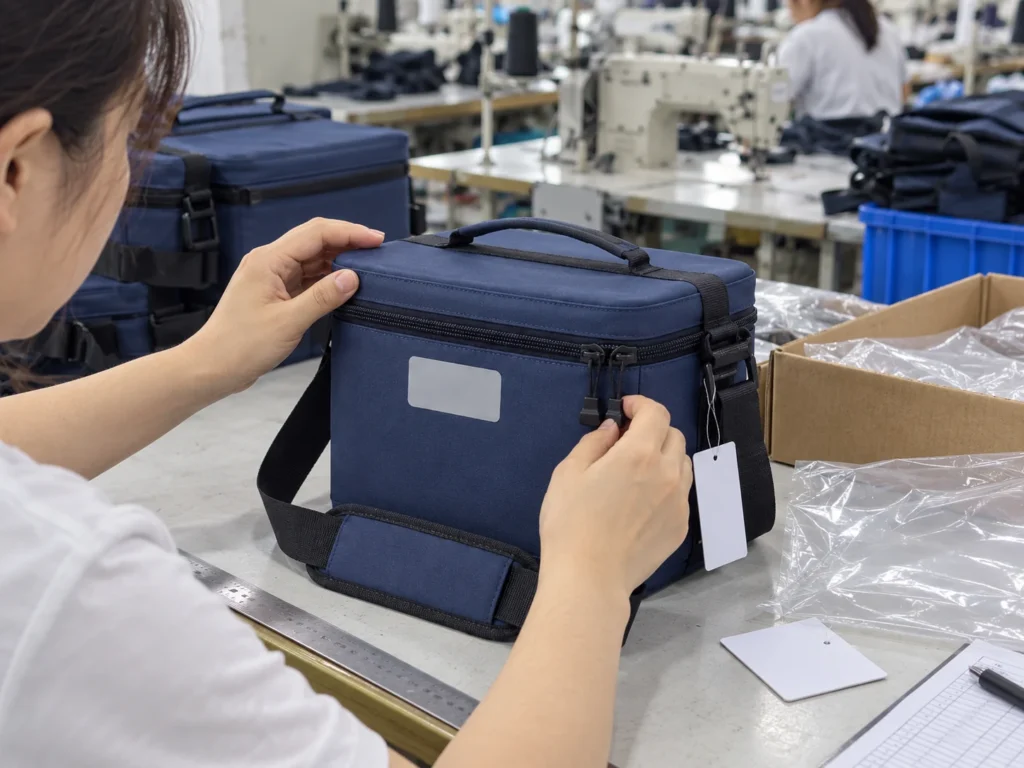
Quick Buyer Checklist Before Production
Before approving the cooler for bulk production, the main decisions should be recorded in one final specification.
| Area | Confirm Before Production |
| Promotional Program | Recipient, intended use and distribution method |
| Bag Structure | Style, finished size, usable capacity and opening |
| Insulation | Lining, foam direction and closure construction |
| Outer Material | Fabric, color and finish |
| Handles / Straps | Carrying method, length, hardware and attachment |
| Logo | Artwork, method, size, color and position |
| Order Breakdown | Total quantity, colors and quantity per version |
| Packing | Individual pack, tag, barcode, color split and carton mark |
| Sample | Finished product physically reviewed and approved |
| Production Reference | Final specifications recorded before bulk production |
This checklist does not replace a complete specification when the product is complex. Its purpose is to prevent major commercial and construction decisions from remaining open when production begins.
If materials, dimensions, branding, packing or structure change after sample approval, the change should be reviewed before being applied to the bulk order.
The approved sample and confirmed specification can then serve as the production reference, while inspection points are arranged around the agreed requirements. More detail on this stage is available in our quality control process.
Frequently Asked Questions
Can a Promotional Cooler Bag Be Developed From a Reference Photo?
Yes. A reference photo can establish the general direction of the product, including its shape, opening, handles, pockets and approximate branding area.
It does not normally define the complete manufacturing specification.
Internal dimensions, lining, insulation, reinforcement, logo details and packing may still need to be confirmed before sampling or quotation.
If a physical sample, drawing or target dimensions are available, they can make the development brief more precise. Otherwise, the supplier should identify which requirements are fixed and which still need to be decided.
Can One Promotional Cooler Bag Order Include Several Colors?
It may be possible, but the color breakdown should be discussed before the order is finalized.
An order of 3,000 pieces in one color is not necessarily the same production arrangement as 3,000 pieces divided among six colors.
Different fabrics, webbing, zippers, logos or labels can affect material purchasing and production allocation.
Provide both the total quantity and expected quantity per color when requesting a quotation. If the final split has not been decided yet, identify it as an open requirement.
How Should Buyers Compare Quotes From Different Cooler Bag Suppliers?
First confirm that every supplier is quoting the same specification.
Two quotations can appear similar while using different assumptions for outer fabric, lining, foam, zippers, straps, logo methods or packing.
A lower unit price therefore does not necessarily represent the same product at a better cost.
Clarify what each quotation includes and which specifications remain open before comparing prices.
Can the Same Cooler Bag Design Be Adjusted for Different Promotional Programs?
Often, yes.
A basic cooler structure may be adapted by changing the size, fabric, insulation direction, pockets, straps, branding or packing.
For example, a simpler version may suit an event giveaway while a more structured version of the same general design may be developed for corporate gifting.
However, significant structural changes can affect the pattern, materials, quotation and sample. Once the differences become substantial, the new version should be treated as a separate development rather than assumed to be the same product with minor changes.
Promotional cooler bags are easier to develop when the intended program, target cost and product specification are considered together. Define how the bag will be used first, then confirm the structure, insulation, branding and packing around that requirement. A physical sample can resolve the remaining details before bulk production follows the approved version.