
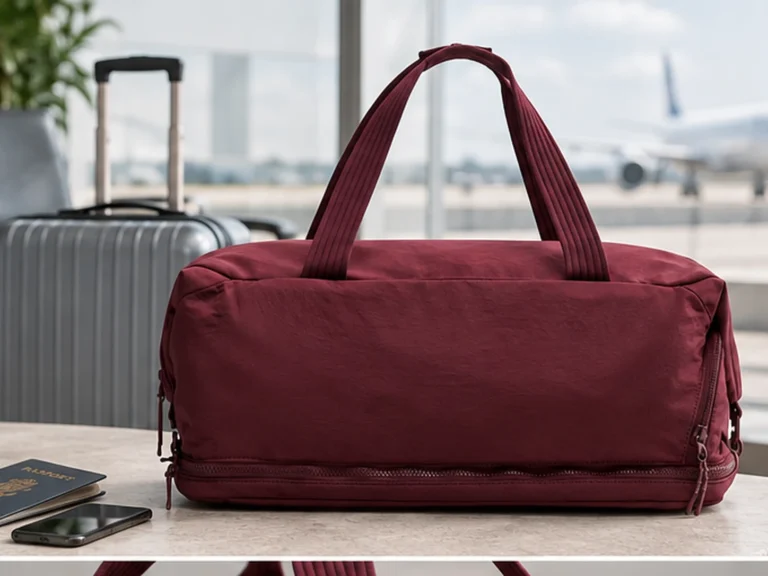
Yes. A duffel bag can be used as a personal item if its packed external dimensions meet the airline’s current rules and it can be stowed where required, usually under the seat in front of you.
A duffel is not automatically a personal item simply because it is small or soft-sided. Airline limits vary, and the bag’s loaded size—not just its empty specification—determines whether it fits the intended travel use.
This guide explains the difference between personal items and carry-ons, how to measure a packed duffel, and how pockets, padding, expansion and other design choices affect its final dimensions.
| Quick answer A duffel can work as a personal item when its loaded external dimensions meet the airline’s current size and stowage requirements. There is no universal personal-item size, so travelers should check the operating airline before departure. |
A Duffel Bag Is Not Automatically a Personal Item
“Personal item” describes a baggage category, not a particular bag shape.
Depending on the airline, a personal item may be a backpack, purse, briefcase, laptop bag or compact duffel. What matters is whether the item meets the carrier’s size and stowage requirements.
American Airlines currently limits personal items to 18 × 14 × 8 inches (45 × 35 × 20 cm) and requires them to fit under the seat in front of the passenger.
Spirit Airlines currently uses the same maximum—18 × 14 × 8 inches—and explicitly states that handles and wheels count toward those dimensions. The personal item must be stored in the under-seat space.
Southwest Airlines uses a different presentation. Its current carry-on policy gives an exact limit for the larger carry-on bag, but for the personal item it primarily states that the item should fit under the seat and gives examples such as a purse, briefcase, laptop case or backpack.
There is no single personal-item dimension used by every airline.
Before travel, the duffel needs to be compared with the current policy of the airline actually operating the flight.
Personal Item and Carry-On Are Not the Same Category
The terms are often used together, but a personal item and a carry-on normally serve different roles.
A personal item is generally the smaller piece intended for under-seat storage. A standard carry-on may be larger and is usually designed around overhead-bin limits.
| Baggage type | American Airlines published maximum |
| Personal item | 18 × 14 × 8 in |
| Carry-on bag | 22 × 14 × 9 in |
American Airlines states that its carry-on measurement includes handles and wheels. Spirit currently lists 18 × 14 × 8 inches for a personal item and 22 × 18 × 10 inches for a carry-on.
A product described as a carry-on duffel bag can therefore still be too large to qualify as a personal item. Likewise, a compact duffel may work as an under-seat personal item even though its basic construction looks similar to a larger carry-on model.
The category depends on the actual dimensions and the airline’s rules—not on the word “duffel” printed in the product title.
Airline Personal-Item Rules Vary
The differences between airlines are easier to see with a few current examples.
Airline examples checked in September 2026. Policies can change, so travelers should verify the operating airline’s current baggage rules before departure.
| Airline | Current personal-item direction | Why it matters |
| American Airlines | Max. 18 × 14 × 8 in; under-seat storage | Uses a defined dimensional maximum |
| Spirit | Max. 18 × 14 × 8 in including handles and wheels; under-seat storage | External attachments count toward size |
| Southwest | Personal item goes under the seat; current policy page gives examples rather than one fixed 3D personal-item size | Shows why not every carrier uses the same published format |
This is why a single number such as 18 × 14 × 8 inches should not be presented as a universal airline standard.
It is a real limit used by some major U.S. carriers, but it does not automatically represent every airline, route or partner carrier.
For a traveler, the solution is to verify the current rule before flying. For a bag brand, the implication is different: avoid broad product claims such as “fits every airline” unless they can actually be substantiated.
Measure the Duffel When It Is Packed, Not Only When It Is Empty
This is where soft duffel bags become more complicated than a rigid suitcase.
An empty soft-sided bag does not always keep the same profile once it is filled.
Suppose a specification lists a duffel at 17 × 13 × 8 inches. That number may describe the body in an unloaded or lightly filled condition.
Normal packing can change the shape. Clothing can push the side panels outward. A filled front pocket adds depth. Shoes placed in an end compartment can push the end panel farther out. The top zipper may rise as the main compartment fills, while a structured base can prevent the bottom from compressing.
The measurement that matters for real travel use is therefore the loaded external dimension.
- Pack the duffel with the type of contents it is expected to carry.
- Close all zippers normally without forcing the bag into an artificially compressed shape.
- Place it on a flat surface.
- Measure the furthest external points for length, width and height.
- Account for protruding parts when the airline’s rule says they are included.
For product development, the same principle should be applied during sample review. If a travel duffel is being developed around a personal-item target, the sample should be measured in a realistic loaded condition rather than approved solely from an empty tech-pack measurement.
Otherwise, a specification that appears correct on paper may produce a finished bag that becomes too deep or too tall during ordinary use.
Every Feature Uses Part of the Dimension Budget
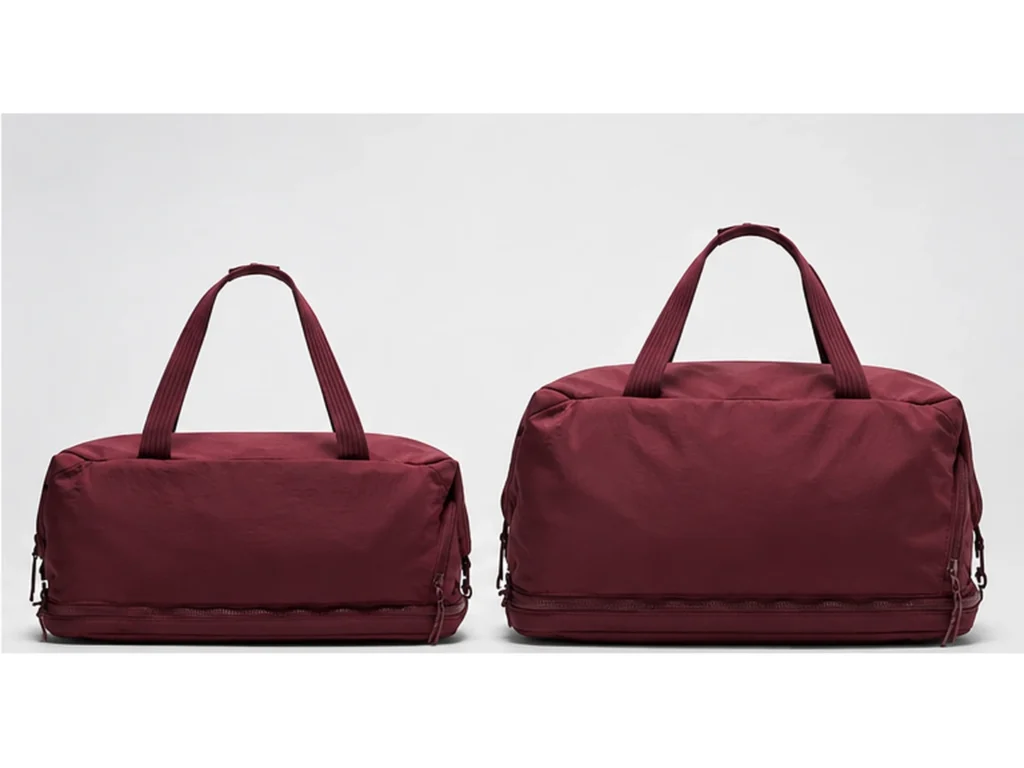
When a duffel is being designed around a restricted external size, each feature uses part of that available space.
A useful way to think about this is a dimension budget.
Pockets, foam, bottom panels and separate compartments can all improve the product. They can also increase the external profile once the bag is loaded.
On a large checked duffel, a small increase may not matter much. On a compact under-seat design, several small additions can be enough to change whether the final shape stays within the original dimensional target.
Shoe Compartments Are Not Free Capacity
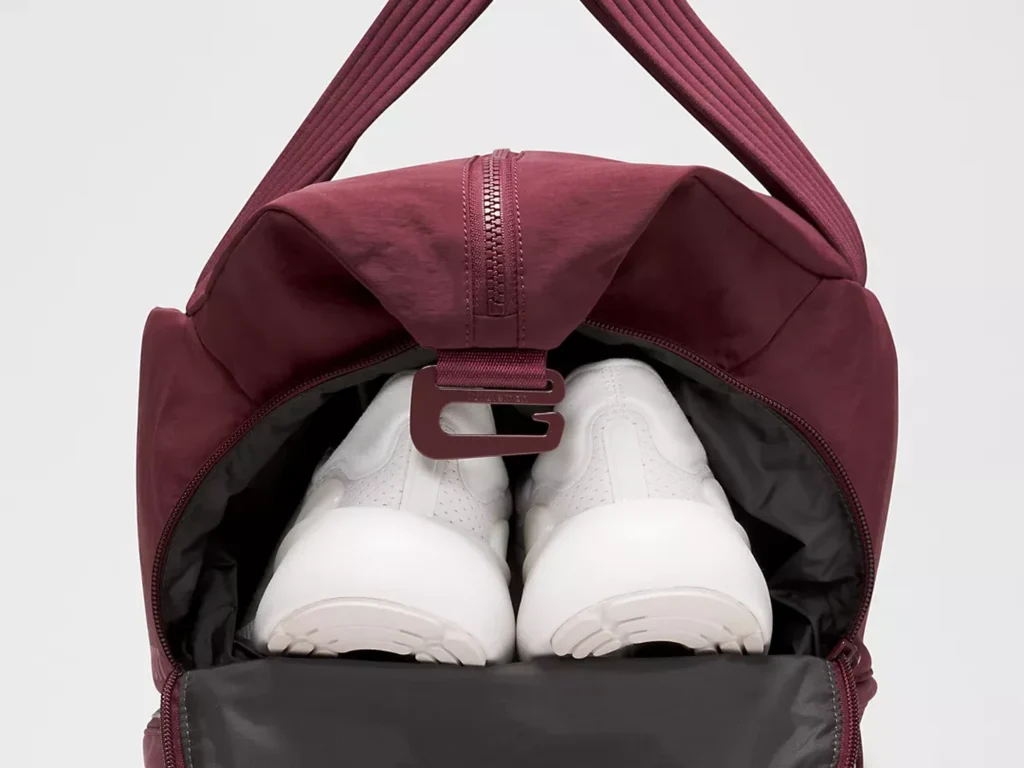
A shoe compartment can be valuable for gym, sports and travel bags, but it still occupies physical space.
- a separator panel
- a dedicated zipper
- seam allowance
- lining
- reinforcement
- sometimes ventilation components
Once footwear is inserted, the compartment can also push the end panel outward or reduce the usable volume of the main compartment.
If a compact duffel needs both shoe storage and a strict external envelope, the pattern may need to redistribute volume elsewhere rather than simply adding the compartment onto an existing design.
External Pockets Change Depth When Filled
A front pocket often looks almost flat when empty. Fill it with a charger, travel documents, headphones, toiletries or another accessory and the outer profile changes.
That extra projection becomes part of the real measurement. A travel sample should therefore be assessed with the pockets being used as intended—not only with the main compartment filled.
The useful question is not simply: How large is the empty shell? It is: How large is the product in normal use?
Padding and Bottom Support Trade Flexibility for Structure
Foam can help protect contents and give a duffel a cleaner shape. A bottom board can keep the bag stable when loaded. Both also reduce flexibility.
A structured base is harder to compress into a restricted space. Thicker foam adds wall thickness even before anything is placed inside the bag.
At the other extreme, a very soft construction may adapt more easily but lose shape when heavily packed.
There is no single best construction. Protection, appearance, capacity and dimensional flexibility all compete for the same physical space.
Handles and Hardware Can Affect the Final Measurement
The fabric body is not always the furthest point of the finished product.
- padded handles
- buckles
- webbing adjusters
- zipper guards
- feet
- reinforced end panels
- other external components
Spirit, for example, explicitly includes handles and wheels when measuring a personal item.
Measure the complete finished bag, not only the main fabric panels.
Soft-Sided Construction Helps, but Compression Should Not Be the Design Strategy
Soft-sided duffels have a real advantage over rigid luggage: the body can adapt slightly to irregular spaces.
That flexibility is useful, but it should be treated as tolerance rather than the primary method for meeting a dimensional limit.
A bag filled mostly with clothing may compress reasonably well. The same bag behaves differently when it contains shoes, a laptop, bottles, a structured toiletry case, books or other rigid objects.
Its construction can also limit compression. Bottom boards, reinforced end panels and heavy padding all make a nominally soft bag behave more like a structured product.
Designing around the assumption that “the passenger can squeeze it into the sizer” creates an avoidable risk.
A more reliable personal-item-oriented design remains close to its intended external dimensions during normal use. Softness then provides some practical flexibility instead of rescuing an oversized product.
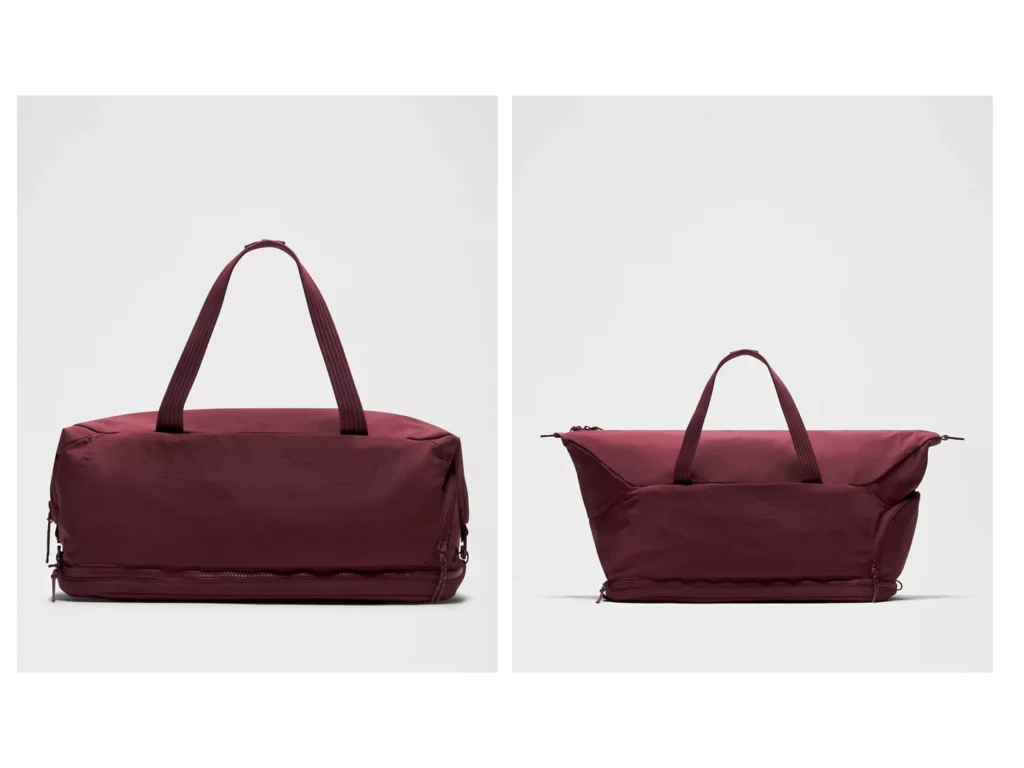
Expandable Duffels Have Two Different Size States
Expansion zippers create another dimensional issue.
An expandable duffel effectively has at least two configurations.
Closed State
With the expansion panel zipped shut, the bag has its compact external profile. This is often the dimension that appears most prominently in a product specification.
Expanded State
Opening the expansion section adds usable space, but it can also add depth or height.
If the product is being designed around a personal-item target, the two configurations should be treated as separate specifications.
- closed dimensions
- expanded dimensions
- usable capacity in each state
This avoids a situation where a product is promoted using its smallest dimensions even though normal use frequently involves expanding the bag.
During sample review, the expanded version should also be checked for changes in stability, zipper load and overall shape.
If only the closed state was designed around a particular travel-size target, the product description should make that distinction clear.
Liters Do Not Determine Whether a Duffel Is a Personal Item
A liter rating describes internal volume. It does not tell the traveler whether the loaded bag meets an airline’s external size rule.
Two 20L duffels can have very different proportions. One may be long and shallow. Another may be short and deep.
The internal capacity can be similar while their behavior in an under-seat space is completely different.
The same applies when comparing products labeled 20L, 25L or 30L.
A larger capacity does not automatically mean a bag fails a particular dimensional limit, and a smaller capacity does not guarantee that it fits.
A travel product page is more useful when it shows both capacity and external dimensions rather than treating the liter rating as a substitute for size.
For a size-sensitive product, development is also easier when the sequence starts with the target external envelope and then optimizes the usable internal volume inside it.
Carry Systems Also Affect the Design
A compact duffel still needs to move comfortably through an airport, station or hotel.
- short handles
- detachable shoulder straps
- backpack straps
- trolley sleeves
These features can improve usability, particularly when the traveler is also pulling a rolling suitcase. They also add components.
Backpack-style carry may require extra webbing, buckles, reinforcement and strap storage. A trolley sleeve adds construction to the rear panel. A padded shoulder strap contributes additional bulk and weight.
The aim should not be to add as many carrying methods as possible.
Which carrying methods solve a real use problem without adding unnecessary weight, thickness or construction complexity?
Annabelle Bag already develops multi-carry duffel structures. One existing 30L gym-duffel direction supports hand carry, shoulder carry and backpack-style carry.
That product should not be interpreted as automatically meeting a personal-item limit; no such claim is being made here. It is simply an example of how carrying structures create functional trade-offs during product development.
How to Design a Personal-Item-Oriented Duffel
For a size-sensitive travel product, it is usually more reliable to define the external dimensional target before maximizing capacity.
Many bags are developed in the opposite order: capacity is selected first, compartments are added, padding follows, and the external dimensions are checked near the end.
external envelope → structure → usable capacity
A personal-item-oriented project benefits from reversing that sequence.
Start With the Intended External Envelope
The product brief should define the dimensional target the bag is being developed around.
That does not mean claiming compatibility with every airline. It gives the pattern maker a measurable design constraint.
A brand might choose an external envelope based on the specific travel market or airline policies it wants the product to address. That target then becomes part of pattern development rather than a marketing specification added after the sample has already been made.
Establish the Main Compartment Before Secondary Features
The main body usually provides most of the usable volume.
Once its proportions are defined, secondary features can be evaluated against the remaining dimension budget.
If a shoe compartment pushes the end outward, the main compartment may need to be adjusted. If a padded laptop sleeve increases thickness, another part of the bag may have to become shallower.
This is more controlled than continuing to add features until the finished sample has drifted beyond the original size target.
Use Structure Where It Has a Purpose
Not every panel needs equal reinforcement.
One product may benefit from a stable base, a lightly padded rear panel and flexible side walls. Another may prioritize packability and use less foam and fewer rigid inserts.
The right construction depends on the intended use. A compact travel bag does not need to be as soft as possible; it needs enough structure to perform its function without using unnecessary external space.
Evaluate the Sample With Realistic Contents
A flat drawing cannot show exactly how the finished bag will behave under load.
Testing a sample with representative contents—clothing, shoes, toiletries, chargers or a laptop—can reveal side-panel bulging, end pockets extending outward, top zippers lifting, or the base widening under load.
At this stage, external dimensions become a real functional requirement rather than simply a number in the specification.
When a Duffel Should Not Be Marketed as a Personal-Item Bag
A compact duffel can be suitable for under-seat travel without supporting a universal airline claim.
A brand should be cautious if:
- only the empty bag meets the intended dimensions;
- the normal loaded state is clearly larger;
- an expansion section exceeds the target when opened;
- filled external pockets substantially change the profile;
- rigid parts prevent the bag from fitting naturally;
- the bag only fits when heavily compressed.
Claims such as “Fits Every Airline,” “Airline Approved,” or “Guaranteed Personal Item” can be difficult to support because baggage policies differ and can change.
More precise language focuses on measurable product characteristics: compact soft-sided travel duffel, designed around a defined external size, compact under-seat travel direction, published external dimensions, and a reminder to check the current airline limit before travel.
A manufacturer can control the bag specification. It cannot control future airline policies or how individual carriers apply them.
Quick Reference: When Can a Duffel Work as a Personal Item?
- its loaded external dimensions meet the airline’s current requirements;
- it can be stored where the airline requires, typically under the seat;
- filled pockets and expansion sections do not push it beyond the applicable limit;
- the product does not depend on aggressive compression to fit.
The word “duffel” itself does not determine the baggage category. The loaded size and the airline’s current rule do.
Frequently Asked Questions
Can a duffel bag be a personal item?
Yes. A duffel can be used as a personal item when its packed external dimensions meet the airline’s current requirements and it can be stored in the required location.
Whether a bag is called a duffel, backpack or tote does not by itself determine its baggage category.
What size duffel bag can be a personal item?
There is no single personal-item size shared by every airline.
Some carriers publish exact maximum dimensions, while others primarily require the item to fit under the seat. Travelers should check the operating airline’s current policy and compare it with the bag’s loaded external dimensions.
Does a soft duffel count differently from a hard bag?
Not necessarily.
A soft-sided construction may make a duffel easier to fit into a restricted space, but softness does not create a different baggage classification. A heavily packed soft bag can still become too large, and rigid contents or structural components can significantly reduce its ability to compress.
Does a 20L or 30L duffel automatically qualify as a personal item?
No.
Liter capacity measures internal volume rather than external length, width and height. Two bags with the same capacity can have very different proportions, so airline suitability should be evaluated from the actual external dimensions rather than capacity alone.
Designing Around Real Travel Use
A personal-item-oriented duffel is ultimately a problem of dimensional design.
Capacity, pockets, padding, expansion and carrying systems all compete for the same limited external space.
external dimensions first → structure second → capacity optimization third
That approach makes it easier to see what each feature costs in terms of space and reduces the chance that the finished sample drifts away from its intended travel use.
For brands developing custom travel or duffel bags, Annabelle Bag can review the target dimensions, compartment arrangement, carrying structure, material direction and branding requirements before sampling. Related resources include our foldable travel bag design guide and a documented custom duffel bag sample development case.
The goal is not to attach a broad “airline approved” label to the product. It is to develop a bag around clear, measurable requirements and describe the finished product accurately.