
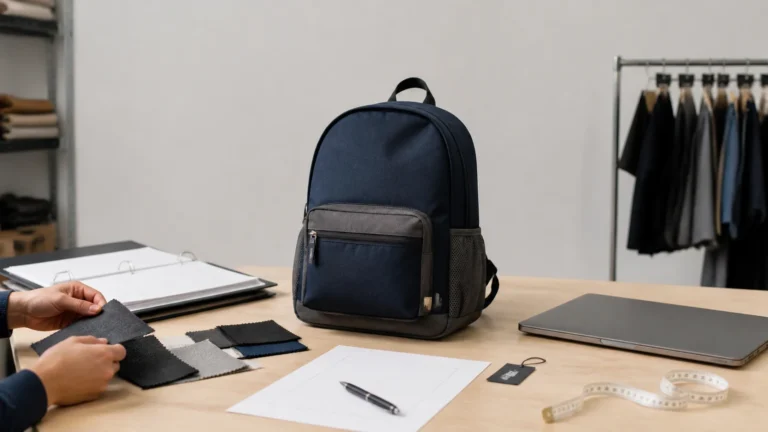
A retail buyer sourcing bulk school backpacks can have a reference photo and total quantity and still be too early for sampling.The photo does not define who will use the bag, what it needs to carry, the target buying price or the retail details that belong to the program. Before paying for a sample, the buyer should settle a few practical decisions that the reference photo cannot answer.
Figure 1. School backpack project path before sampling
Reference photo or product link
↓
Define user, load and basic dimensions
↓
Set target price and protected results
↓
Check MOQ, colors, prints and retail versions
↓
Confirm sample fabric, construction and artwork
↓
Mark unfinished retail files as pending
↓
Make and load-test the sample
↓
Approve one final written specification
The flowchart is a publishing aid. It summarizes the approved article without adding a new company claim.
Check what must fit, not only the outside dimensions
A standard middle school backpack often starts around 42 to 45 cm high, 30 to 32 cm wide and 14 to 18 cm deep. This is a working range rather than a fixed size. The correct dimensions depend on what students will put inside and whether those items can pass through the opening.
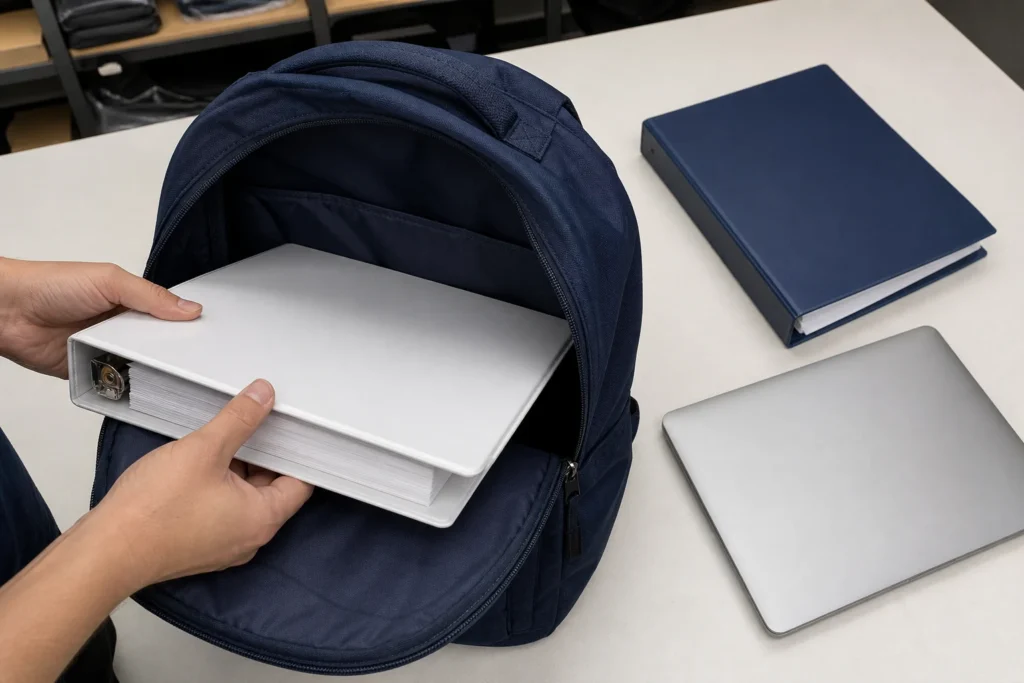
For a North American program, a 2-inch three-ring binder measuring around 30 × 28 × 5 cm is a useful reference. Books, stationery and a water bottle will use the remaining space. If the backpack also targets high school or university students, the buyer may need to consider a laptop or tablet compartment.
Outside dimensions alone do not confirm capacity. A backpack may look compact and well proportioned from the front but have a narrow opening at the top. A tight zipper curve can create the same problem.
This often becomes clear only when someone tries to load the sample. A rigid A4 binder may catch at both ends of the zipper. A 15.6-inch laptop may fit inside the body but still be difficult to pass through the opening. Turning it at an angle is not a good solution. Repeatedly forcing a rigid item through a narrow opening puts unnecessary pressure on the zipper and the item itself.
Check the backpack with the largest item it is expected to carry. The item should pass through the opening without being forced, sit fully inside and allow the main zipper to close normally.
The buyer should also look at the usable depth. A large front pocket can make the backpack appear deeper without adding much room to the main compartment. Padding, lining and internal pockets reduce usable space as well.
The right size is therefore a combination of the outside measurements, the clear space inside and the shape of the opening. A reference photo can suggest the overall proportion, but it cannot confirm any of these points.
Table 1. Basic fit checks before sampling
| What to check | Working reference | What the sample should confirm |
| Backpack body | Around 42–45 cm high, 30–32 cm wide and 14–18 cm deep for a standard middle school direction | The proportion suits the target age group |
| Three-ring binder | Around 30 × 28 × 5 cm for a standard 2-inch binder | The binder passes through the opening and sits fully inside |
| A4 binder | Use the rigid binder intended for the market | The corners do not catch at the zipper ends |
| Laptop compartment | Use the intended laptop size, such as 15.6 inches when applicable | The laptop enters without being tilted or forced |
| Main opening | Check the width and zipper curve, not only the bag height | The zipper closes normally after the bag is loaded |
| Water bottle pocket | Test with the expected bottle size | The pocket depth and elastic opening hold the bottle securely |
| Usable depth | Measure after lining, padding and pockets are installed | The main compartment still has enough clear space |
Decide what to protect when the target price is tight
Many school backpack inquiries begin with a request to copy a reference product. The first quotation may be higher than the buyer expected because it reflects the materials, pockets, padding and components shown in the reference.
Waiting until after sampling to discuss the target price creates unnecessary work. The first sample may contain features that will later be removed, which means the revised product may need another round of development.
The buyer should first decide which results must remain.
For a low-price supermarket backpack, the product still needs to look acceptable on the shelf. The front shape should remain clear. The bag should not collapse when empty, and the print or logo should have a normal retail appearance.
Basic carrying performance also has to remain. The shoulder strap connections need suitable stitching and bartack reinforcement. The contact area on the shoulder needs some cushioning. The handle must be reinforced, and the main zipper should support normal use. The bottom needs enough structure and abrasion resistance for the expected load of books.
These results matter more than the number of small pockets inside the backpack.
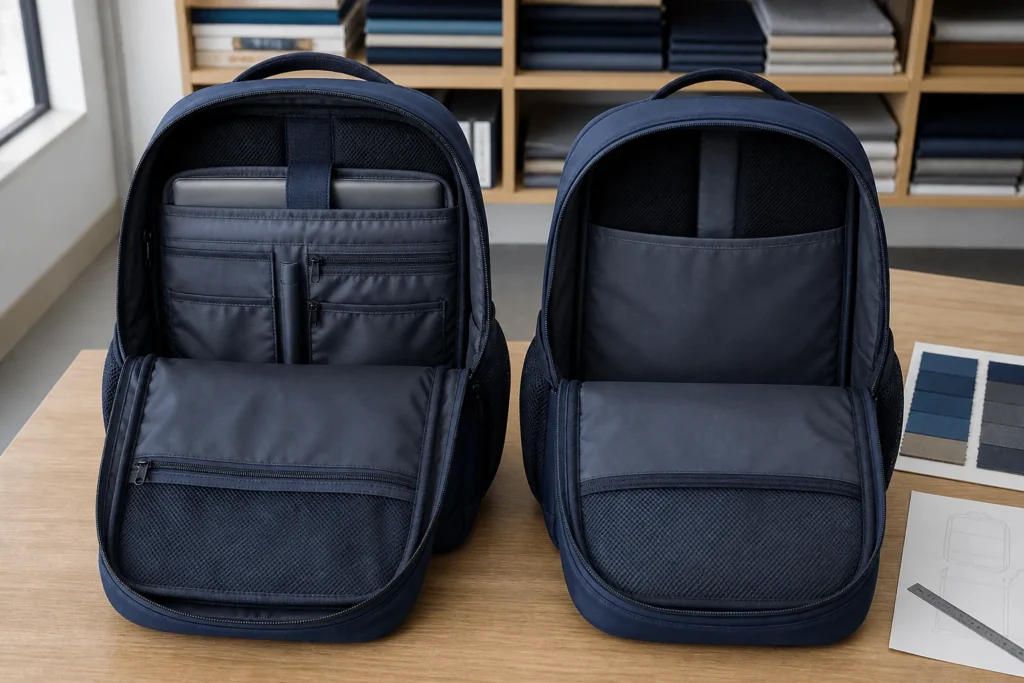
When the reference is over budget, the internal construction is usually the first place to review. Several pen and card slots can become one open pocket. A zippered hidden pocket may be removed. A complicated computer compartment can be simplified if the intended user does not need it.
The back panel and padding are another area to examine. A shaped or heavily padded construction uses more material and sewing time than a basic school backpack may require. The agreed level of comfort should remain, but the construction behind it may be simpler.
Zippers, pullers and buckles are worth checking next. A customized metal puller may cost more without adding the same value to a basic supermarket backpack.
Do not change the outer fabric by default. It may be the reason the reference looks right on the shelf. If the buyer wants to keep that appearance, leave the outer material and main shape alone. Look for savings in the hidden sewing work, internal pockets and back construction.
The trade-off changes when the padded laptop compartment or back support is central to the product. A standard outer fabric may then leave more of the budget for the padding and internal structure.
Ask the supplier to write out both specifications. One can follow the reference more closely. The other should name the pockets, materials or components that were removed or replaced to reach the target price. Compare the actual changes before deciding which version to sample.
Table 2. What to protect and what can be adjusted
| Protect first | Why it matters | Areas that may be adjusted |
| Clear front shape | A collapsed backpack has a poor shelf appearance | Simplify hidden panels or internal construction |
| Normal logo or print appearance | It carries the visible retail identity | Change internal pockets before reducing artwork quality |
| Shoulder strap attachment | A weak connection can become a complaint or return risk | Simplify the back panel while keeping the stress points reinforced |
| Basic shoulder cushioning | Students still need reasonable carrying comfort | Review foam type or thickness according to the agreed use |
| Reinforced handle | The handle carries the loaded backpack during normal use | Remove decorative construction that does not improve strength |
| Functional main zipper | It must support normal loading and opening | Replace customized pullers or specialized components where suitable |
| Supported bottom | Books should not cause obvious deformation | Simplify hidden pockets or internal binding first |
Consider the MOQ before dividing the order
Most custom school backpack programs have a minimum order quantity. The fabric, color, printing, components and packing all require some production preparation, so a custom order cannot usually be divided into an unlimited number of small versions.
The exact MOQ is not the same for every supplier or specification. A backpack made with available fabric and standard components may be easier to produce in a smaller quantity than one that requires a custom Pantone color, special print, exclusive buckle or separately developed material.
At Annabelle Bag, the minimum order quantity for custom backpack production starts at 300 pieces. This is the starting quantity for the overall order. The workable quantity for each color or print still depends on the specification and the way those 300 pieces are divided.
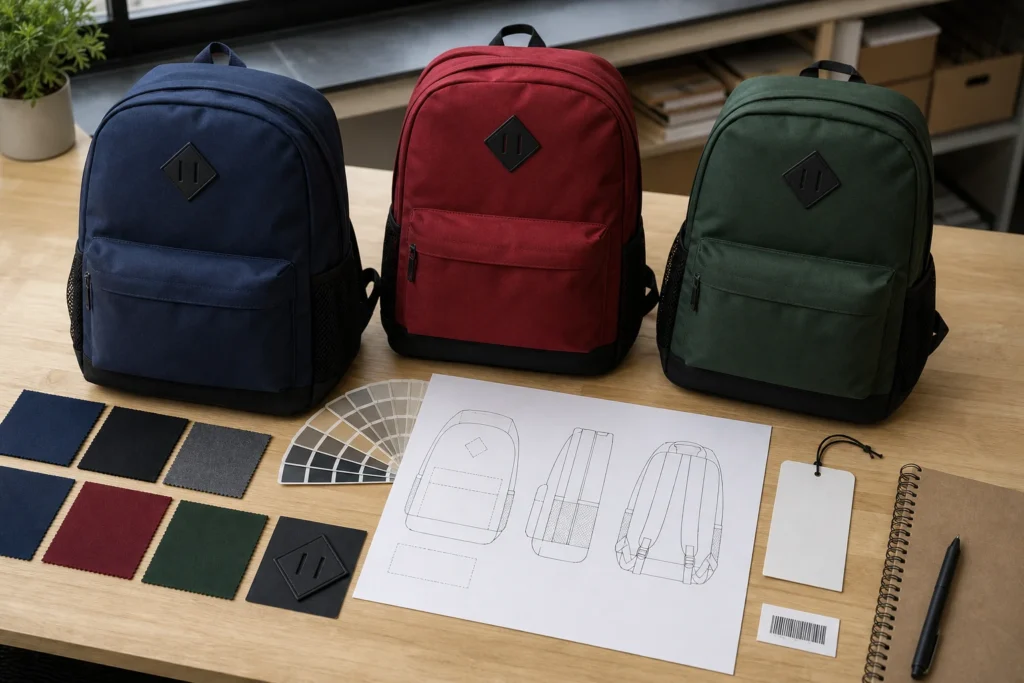
One color with one print is relatively straightforward. The same total divided among several colors, prints or themes needs more preparation, even when the backpack construction remains unchanged.
Each visible version may also have its own barcode, hangtag or retail label. A Back-to-School range sold in more than one country may require different packaging language as well.
The buyer does not need to complete every retail file before the first discussion. It is enough to state how many colors, prints or themes are being considered and give an estimated quantity for each one.
Where the quantity behind each version is limited, common components can make the program easier to produce. Different outer colors may use the same lining, zipper, buckle and webbing. The print can change while the size and construction remain the same.
If the order requires a custom fabric color, special print or exclusive component, the relevant material or component may have its own MOQ above the backpack order quantity. That requirement should be checked before the sample specification is fixed.
The first sample also needs a clear role. The buyer should identify which color and artwork it represents and whether the remaining versions will use the same size, pockets, materials and components.
The total order quantity is only the starting point. The supplier also needs to understand how much production volume remains behind each actual version.
Define the artwork on the product, not only on the screen
A school backpack may use screen printing, heat transfer, a woven label or a PVC patch. The artwork and the surface of the backpack should be considered together.
Fine lettering may lose definition on coarse fabric. A print that crosses a seam can become uneven. Artwork placed too close to a zipper or pocket edge may be interrupted after the panels are sewn together.
These issues are difficult to judge from the artwork file alone.
The buyer should mark the intended size and position on the reference. If the placement must stay within a particular panel, include that limit as well. A logo described only as “on the front” still leaves too much room for interpretation.
Color also needs a usable reference. This can be a Pantone number, a physical fabric swatch or an existing product sample. A screen image may show the general direction, but screens do not provide a reliable standard when an exact match is required.
If the program includes several themes, identify which artwork belongs to each one. Similar filenames are easy to confuse. The relationship between color, print and barcode should be clear before the final versions are prepared.
The sample should show the selected logo method, size and position on the actual fabric. That is the point at which the buyer can judge edge definition, proportion and visibility as part of the finished backpack.
Separate what must be fixed from what can remain pending
A buyer does not need a complete technical pack to begin discussing a bulk school backpack. A reference photo or product link is enough to establish the product direction.
However, a useful quotation needs more than the photograph.
The basic dimensions should be decided before the quotation is finalized. The buyer should also provide the expected total quantity, target buying price, target age group, selling market and the main items the backpack must carry.
These details determine whether the reference is suitable in its current form. They also show whether the quotation should follow the original construction or present a simpler alternative.
Before sampling begins, the product direction needs to be more specific. The buyer should identify which retail version the sample represents, which visible details must remain and which parts may be adjusted to reach the target price.
The fabric and color direction should be clear. So should the main pocket structure, shoulder straps, back panel, logo method, logo size and logo position.
Not every retail file needs to be finished at this point.
Final barcode files, hangtag artwork and carton marks are often supplied later. Some packaging language or store distribution information may also remain open. These items can be marked as pending instead of being filled with guessed information.
The packaging direction itself should still be known. The buyer should state whether the backpack will use an individual polybag, warning text, hangtag, barcode label, retail price label or multipack arrangement.
This distinction prevents two opposite problems. The project should not be delayed while waiting for a barcode that does not affect the product sample. At the same time, the final packing stage should not discover that the order contains several unplanned retail versions.
Table 3. What must be confirmed and what can remain pending
| Project stage | Information to confirm | Information that may remain pending |
| Before quotation | Basic dimensions, estimated quantity, target price, target age group, selling market and intended contents | Final barcode files, final hangtag artwork and carton marks |
| Before sampling | Sample version, fabric direction, color direction, pocket structure, shoulder straps, back panel, logo method, size and position | Final store allocation and some packaging language |
| During sample review | Capacity, opening, shape, straps, fabric, logo, zipper and agreed components | Only items that do not change the approved backpack construction |
| Before bulk material purchase | Final material requirements, testing, compliance documents and material claims | Nothing that changes the approved material source |
| Before final packing | Barcode, hangtag, retail price label, packaging language, multipack instructions and carton marks | No unresolved retail files that can hold up packing |
State market and testing requirements early
The selling market can affect the materials and documents used for a school backpack. Requirements are not the same for every country, age group or retail program.
Projects may involve colorfastness, tear strength, seam strength, shoulder load, zipper, abrasion, water resistance or chemical testing. A recycled material claim may also require supporting documents.
Requirements related to REACH, CA Prop 65, GRS, OEKO-TEX, CPSIA or PFC-free finishes should not be added automatically to every school backpack. The relevant requirements depend on where and how the product will be sold.
This article focuses mainly on backpacks for middle school students and older users. Products for younger children can involve different warnings, labels and small-component requirements. The intended age group should therefore be stated at the start.
The buyer may not need every report before the first product sample, but the supplier should not be left to guess the target standard. If a particular test, material claim or certificate is required, raise it during the inquiry or quotation stage whenever possible.
Final requirements must be settled before the related bulk materials are purchased and before production begins. A late request can change the material source, add testing time or make the original quotation unusable.
Use the sample to close the open decisions
The sample should answer the questions raised before development. It is not only a visual copy of the reference.
Load it with the items defined for the project. Check whether the binder, books, stationery and water bottle fit without distorting the bag. If a laptop compartment is included, test it with the intended device size.
Open and close the main zipper with the backpack loaded. Check whether rigid items catch near the ends of the opening.
Look at how the bag holds its shape when empty and when filled. The front should retain the appearance expected for the retail program, and the bottom should support the agreed load.
Try the shoulder straps at the intended adjustment range. Check their position, basic cushioning and connection to the backpack. The handle and main stress points should also match the approved construction.
Review the fabric on the physical sample. Color, surface, backing and hand feel may not appear accurately in a reference photo or digital rendering.
The logo or print should be checked for size, position, color and edge definition. Zippers, pullers and buckles should match the quotation or approved specification.
If a temporary material or component has been used in the sample, the difference must be identified. The buyer should know exactly which details represent bulk production and which still require a separate approval.
A reply that only says “sample approved” leaves too much room for confusion.
The final approval should be connected to one written specification. It should identify the accepted dimensions, construction, fabric, color reference, pockets, artwork and components. Packaging details that are already available should be included. Anything still pending should remain listed as an open item.
This is especially important when corrections have been discussed in several email threads. The final record should show which changes were accepted instead of forcing the buyer and supplier to reconstruct the decision later.
Frequently Asked Questions About Bulk School Backpack Sampling
What information should a buyer provide before sampling a bulk school backpack?
Start with a reference photo, product link or existing sample. Add the target market, intended age group, what students will carry, target unit price and estimated order quantity. If more than one color or print is planned, give the likely quantity split. Any certification, logo, labeling or packing requirement that may affect the materials or construction should also be mentioned before sampling. Barcode numbers and final carton marks do not need to be ready at this stage.
What is the MOQ for custom school backpacks?
Most custom fabrics, colors, printing methods and components have their own minimum order requirements. Annabelle Bag’s factory MOQ for custom school backpacks starts at 300 pieces. This is the starting point for the program, not a guarantee that 300 pieces can be divided into any number of colors or designs. The workable split depends on fabric availability, print setup and which components can be shared across the order.
Can a 300-piece order be divided into several colors or designs?
Possibly. Three hundred pieces in one color is simpler than three designs of 100 pieces each. We first check whether the versions can use the same fabric base, lining, zipper, buckle and construction. Stock colors and a common set of components usually make a smaller split easier to manage. Custom-dyed fabric, separate prints or different retail packaging may create additional minimums, so the planned split should be reviewed before the sample is made.
How can a buyer check whether the backpack fits binders or a 15.6-inch laptop?
Do not rely on the outside dimensions alone. Check the usable internal space as well as the width and shape of the zipper opening. For middle-school programs, a 2-inch three-ring binder, approximately 30 × 28 × 5 cm, is a useful loading reference. If students are expected to carry a 15.6-inch laptop, test that item too. The sample should allow the intended items to enter without forcing the zipper ends.
Can the cost be reduced without making the school backpack look cheap?
Yes, but begin with the parts the shopper will see and the parts that carry the load. The outer shape, visible material and logo may be worth keeping for shelf appearance. Savings can often come from reducing small internal pockets, simplifying the back panel and padding, or using standard zippers and buckles. Shoulder-strap bartacks, basic shoulder cushioning and bottom abrasion resistance should not be reduced to the point that normal use becomes a risk.
Which details can remain pending when the first sample is made?
Some retail files can remain open during the first sample. Final barcode lists, hangtag copy and carton marks may be supplied later if they do not change the backpack itself. The sample still needs a defined user, intended load, target price, quantity direction, sample color or print, material direction and logo method and position. Compliance requirements that affect sourcing should also be stated before quotation, rather than added after the production material has been selected.
When Are Bulk School Backpacks Ready for Sampling?
A school backpack project is ready for sampling when the sample has a defined job.
The buyer knows the intended age group and what the bag must carry. The dimensions and opening have been checked against those items. The target price is clear, along with the appearance and functions that must remain.
The total order quantity has been separated from the number of retail versions. The first sample has an assigned color, artwork and construction. Packaging and compliance requirements are either defined or clearly marked with a later approval date.
Some files may still be pending. That is normal. What matters is that the open items are visible and do not change the product that is about to be sampled.
A reference photo starts the discussion. These decisions turn it into a sample that can be evaluated.