
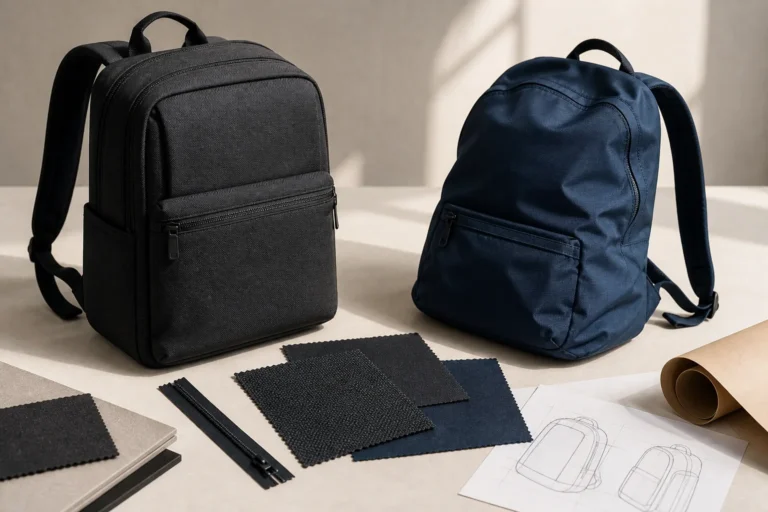
The reference bag was made from 420D nylon, but the inquiry sheet described it as polyester. The mistake looked small on paper. It became obvious in the first sample: the polyester felt firmer, showed a coarser weave and did not drape like the original. For buyers comparing nylon vs polyester bags, the fiber name does not tell you how the finished bag will feel or hold its shape. A useful comparison also has to account for weave, weight, finish, coating and construction. The buyer still needs to check the final choice on a finished sample.
There Is No Useful Winner Until the Finished Bag Is Defined
One brief may call for a soft shell that folds easily. Another needs square panels, stable color across reorders and a tighter target cost. Those are different jobs. Nylon is often shortlisted for the first; polyester is frequently practical for the second. The material name still does not settle the choice, because the fabric construction and the rest of the bag change the finished result.
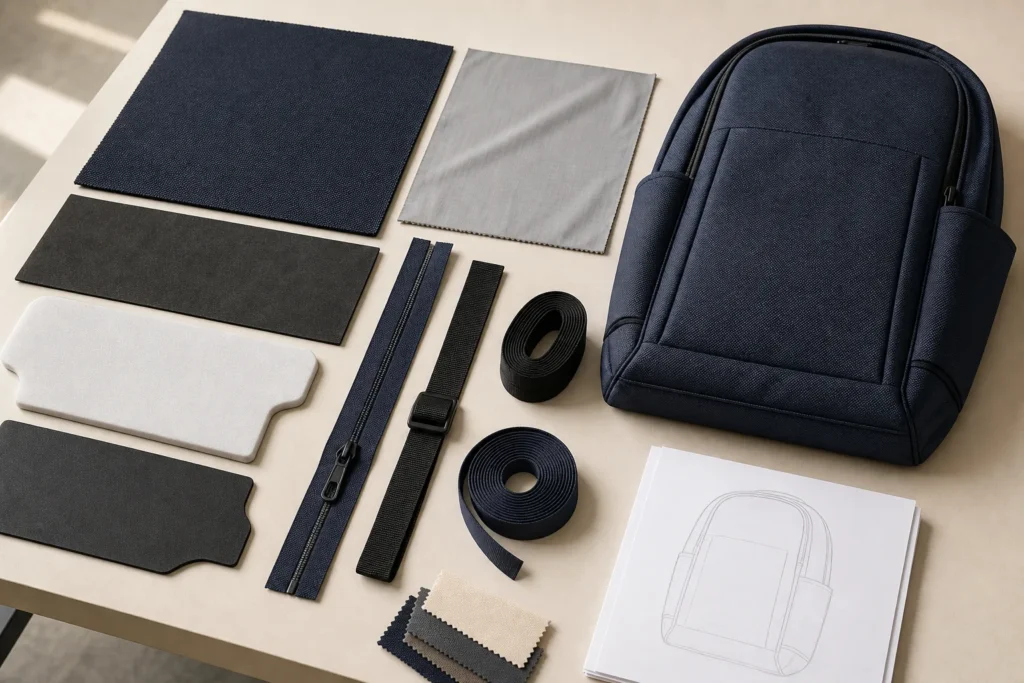
Editorial visualization of the construction layers that should be reviewed together: shell, lining, backing, padding, support, zippers, webbing and sewing work. It does not prove material composition, performance or a customer project.
| If the finished bag needs… | Compare first | Sensible route to sample |
| A softer hand and more fluid drape | Surface feel after finishing and sewing, fabric weight, and recovery after folding | Nylon often starts closer to this brief. Fine polyester constructions should not be ruled out. |
| Firm panels and a clean silhouette | Panel stability after lining and support are added | Polyester is often practical. Nylon can also work when the build provides enough structure. |
| More resistance at rubbing or tear-prone areas | Candidate fabrics under the same test conditions, together with seams and reinforcement | Nylon is commonly shortlisted, but the exact fabric and construction decide the result. |
| A broad color program or repeat custom colors | Approved color, lot consistency, and surface appearance | Polyester is often considered for this route. Custom nylon colors may carry different minimums and lot-control needs. |
| Exposure to light rain or wet surfaces | The finished fabric, coating, seams, zipper, and openings | Neither fiber answers this by itself. The whole build determines what can be claimed. |
| A tight target cost and repeat orders | Stock or custom fabric, color minimums, cutting and sewing work, and repeat availability | Quote a complete polyester and nylon route instead of comparing fabric prices in isolation. |
These are starting points, not material grades. A soft polyester with a light backing may sit closer to the intended hand than a heavily coated nylon, while support layers can make either fabric hold a firmer shape. Choose the two or three results that matter most, then compare materials built into the same type of sample.
That is why a useful comparison of nylon vs polyester bags should begin with the required shape, hand and use—not with a generic winner.
Nylon or Polyester Is Only the First Line of the Fabric Specification
A denier number is useful, but it does not identify one exact fabric. Put two 600D polyester swatches on a table and the difference may be obvious. One can feel crisp and fairly firm. The other may bend more easily and have a smoother back. Both can still be correctly described as 600D polyester.
Denier refers to the linear density of the yarn. The number does not describe the weave, finished fabric weight, surface finish or backing. This is also why a 420D nylon should not be treated as the direct equivalent of a 600D polyester. Compare the physical fabrics under the same conditions instead of using the two denier numbers as a quality ranking.
A material request may begin with only 600D polyester. That is enough for the factory to find possible options, but not enough to approve one for sampling. A clearer note could read:
600D polyester Oxford / matte face / soft PU backing / approved color reference / main body panels
Now the intended surface is clearer. The note also indicates how the back of the fabric should feel, which color reference should be followed and where the material will be used. The final choice still needs an approved swatch and a material reference that both sides can identify later.
The finished bag adds more variables. Lining, foam and panel support can make an assembled panel firmer than the original swatch. A heavy backing may also add bulk around a curved seam or zipper, and the fabric surface can change how a printed or embroidered logo appears.
If nylon and polyester are both being considered, place the candidate swatches beside the reference bag and decide which qualities need to remain. These may include the drape, matte appearance, color, finished weight or panel shape. Check those qualities again on the finished sample before the material description is locked for production.
When the Reference Was Nylon but the Inquiry Said Polyester
The material mismatch also sent the quotation in the wrong direction. Pricing had been based on a standard 600D polyester construction, while the physical reference used 420D nylon with a light, micro-matte PU finish. The first sample confirmed that this was more than a different line on the specification: changing the shell also changed how the bag looked and handled.
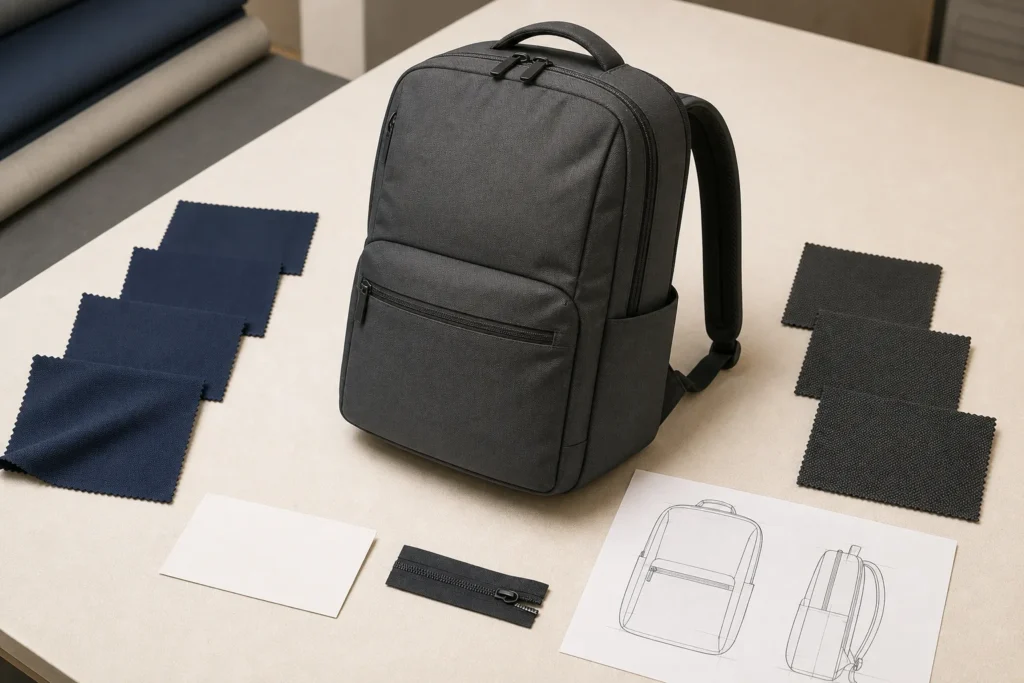
Editorial visualization of one reference bag reviewed against two candidate material routes. It illustrates the anonymized decision process; the backpack and swatches are not the actual customer project, and appearance does not prove fiber composition or performance.
Keeping the nylon was the more direct way to preserve that feel, but it moved the material cost above the original polyester plan. We looked inside the bag for savings instead. Several overlapping pocket layers could be simplified, and smaller dividers could be combined into open or elastic mesh pockets.
A softer PU-backed 600D or 900D polyester was also put beside the reference. It came closer than the first sample, especially in surface and hand, and stayed nearer the original budget. It was still a compromise. The customer could see and feel the remaining difference before deciding which part of the brief mattered more.
After handling both materials and reviewing the revised samples, the customer kept the 420D nylon. The pocket layout was simplified before production, which allowed the exterior to stay close to the reference without treating every internal detail as fixed. The corrected quotation was based on the nylon shell together with the revised sewing work. In this project, the exterior feel was part of the product requirement. Cost was controlled through the simpler interior construction. The revised bag then moved into production.
Match the Material Route to the Bag Construction, Not the Category Name
A category name does not select the fabric. A compact backpack designed to pack flat in luggage and a commuter backpack with a padded laptop section may both be sold as backpacks, yet the material has a different job on each one. Start with the construction that will actually be sampled.
| Representative construction | Material route to consider | What to check on the sample |
| Structured commuter or retail backpack | 600D or 900D matte polyester with suitable backing; a nylon route when a softer or lighter result is required | Panel shape after the laptop section and back padding are added, shoulder-strap attachment, surface appearance and packed weight |
| Hanging toiletry organizer | 300D or 600D polyester, or another approved coated woven shell | Movement around the U-shaped zipper, hanging shape, hook attachment, bottle fit and the way the loaded sections pull on the body |
| Lightweight everyday backpack or crossbody bag | 210D or 420D nylon taffeta or ripstop; a comparable lightweight polyester construction can also be sampled | Hand, sheen or crinkle, recovery after folding, seam behavior and the shape of the bag with its normal contents inside |
| Quilted cosmetic pouch | Fine nylon or polyester shell with the selected padding and lining | Puckering around the quilt lines, zipper movement, logo clarity, folded bulk and the finished hand |
| Travel or gym duffel | A nylon or polyester construction selected to the required strength and abrasion criteria, with suitable base and webbing reinforcement | Base abrasion areas, load path through the handles and webbing, seam attachment and the build of any wet or dry compartment |
These are sampling directions rather than fixed product specifications. A 900D polyester shell may be a sensible start for one structured backpack, but the fabric alone does not hold the laptop section upright. Padding, lining and panel support still affect the shape. The same polyester may also feel unnecessarily heavy on a compact pack designed to fold between trips.
The difference is just as noticeable in softer bags. Quilting changes the way a fine nylon or polyester shell behaves, because the padding and stitch pattern become part of the surface. On a duffel, the fabric carries only part of the load. Handle webbing, base reinforcement and the points where those pieces are sewn into the bag deserve equal attention.
The examples above cover representative custom backpack constructions, cosmetic and toiletry bag constructions and custom travel and duffel bags. They do not mean that every product in a category should use the same fiber or denier. The useful comparison is still between complete sample builds made for the same intended bag.
Water Resistance Comes From the Fabric Build and the Bag Construction
Nylon is not automatically waterproof, and polyester is not automatically more water-resistant. A coated polyester may resist water penetration better than an uncoated nylon in one comparison. Change the coating or construction and the result may change as well.
The first question is what kind of exposure the bag is expected to face. Light rain on a commuter backpack is different from a toiletry bag placed on a wet counter. Moisture inside a cooler bag raises another set of concerns. Those situations should not share one general waterproof claim.
PU coating, PVC backing and TPU lamination are different ways of building or finishing the back of a fabric. Depending on the selected construction, they can affect resistance to water penetration as well as stiffness, weight, odor and hand. A DWR treatment addresses how readily water wets the fabric surface. These terms are not interchangeable. If one of them matters to the project, it belongs in the material specification and should be checked on the actual swatch.
A fabric result also stops at the fabric. ISO 811 is a hydrostatic-pressure method for measuring a fabric’s resistance to water penetration. It does not test the needle holes, zipper, binding or openings of a completed bag. Water can still enter through those areas even when the shell fabric has performed well in its own test.
For an ordinary cut-and-sewn bag, water-resistant is usually the more accurate whole-bag description when the approved construction supports it. Waterproof fabric may be used for a tested fabric when the statement is tied to that material. Claims such as 100% waterproof or leakproof require evidence for the complete bag construction; they should not be inferred from the words nylon, polyester or coated fabric.
Approve the Material Route on Swatches, a Finished Sample, and Any Required Test
A production specification should point back to something both sides approved. The fiber name is part of that record, but it is not the record by itself.
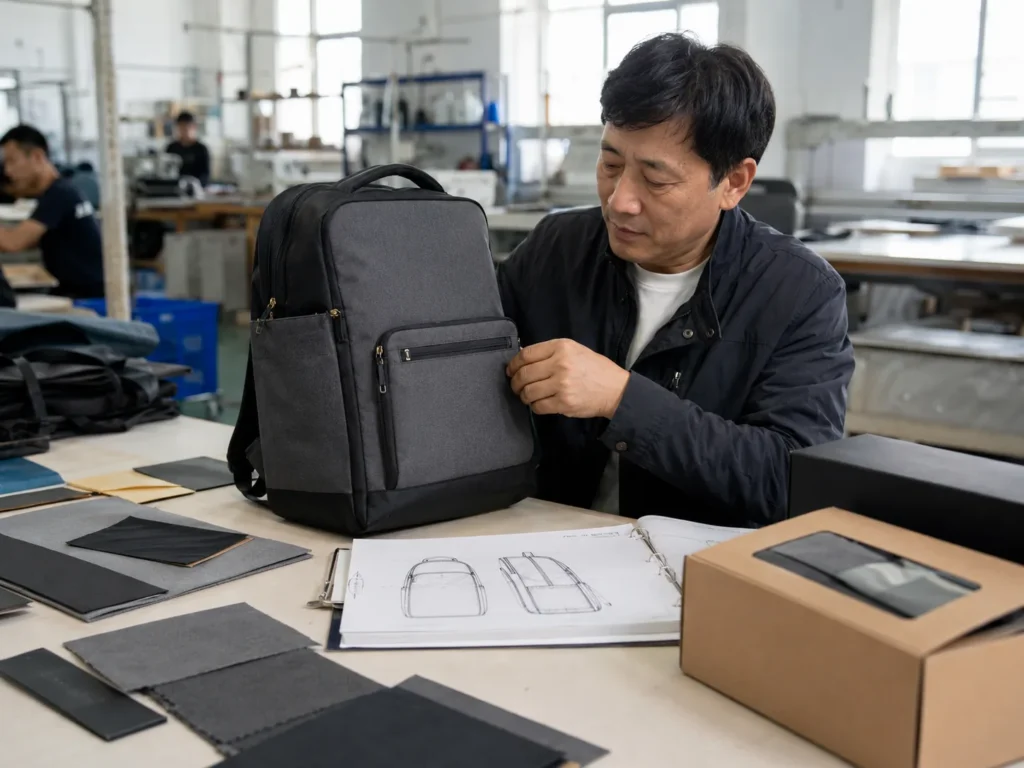
Representative Annabelle Bag sample-review scene. It illustrates the review process; it is not the anonymous customer project described in this article and does not by itself prove a material specification or test result.
Before quotation or material reservation
Give the supplier enough information to select a realistic material route:
- Send the reference bag, approved sample, material specification or a clear product reference. If one feature must remain unchanged, identify it.
- Describe where the bag will be used and what it is expected to carry. Include the target hand and appearance rather than relying only on words such as light, heavy or durable.
- Share the estimated order quantity and color plan. Stock fabric, custom dyeing and several small color runs can lead to different material choices and minimums.
- State whether recycled content is required. RPET should be selected with the required sourcing and documentation agreed for that order, rather than added later as a general environmental claim.
- Name any test method or customer requirement that must be met. A request for “strong fabric” does not tell the laboratory or material supplier what will be measured.
This information is also useful when reviewing bag material and customization options. It helps separate a surface preference from a requirement that affects the quotation, minimum order or test plan.
Check the swatch, then check the sewn bag
Handle candidate swatches together, preferably in the intended color. Look at the face and the back. Fold them, release them and compare how they recover. The surface may appear different under indoor and daylight conditions, and a backing can change both the hand and the odor of the material.
The swatch review should also include the decoration method. Fine printing may lose clarity on a coarse Oxford surface. Embroidery can pull or pucker a lightweight shell, while a patch or label may sit differently on a quilted panel. Approving the artwork on a screen does not answer these material questions.
Then move to the finished sample. Cutting, backing, quilting, binding and sewing all change the way the material behaves. Pack the bag with its intended contents. Check the zipper path, base shape, loaded panels and the points where handles or shoulder straps meet the body. A loose swatch cannot show whether a laptop section makes the back panel too rigid or whether a large toiletry organizer twists when it is hanging.
Use a test method that matches the requirement
Abrasion, tear strength, water penetration and colorfastness are separate questions. If testing is required, record the method, specimen conditions and acceptance point before the material is sent to the laboratory. Candidate fabrics should be compared under the same method and preparation.
One abrasion number should not be treated as a universal durability score. ASTM D3884 explains that abrasion results are affected by the fiber, yarn, fabric construction, finish and test conditions, and that laboratory abrasion is only one factor in actual wear. The test is useful when it answers a defined comparison; it cannot predict every bag’s service life from a cycle count alone.
The selected material can then be recorded by its approved swatch, supplier material code, color reference, backing or coating and intended panel. Add the relevant test report or agreed result when the project requires one. This gives production a repeatable reference and gives the buyer something more reliable than a line that says only nylon or polyester.
Nylon vs Polyester Bags: Frequently Asked Questions
Are nylon and polyester the same material?
No. Both are synthetic fibers, but nylon is a polyamide and polyester belongs to a different fiber family. The names are not interchangeable.
That does not mean every nylon will feel one way and every polyester another. Weave, yarn size, fabric weight, dyeing, finish and backing can change the result quite noticeably. A coated nylon may feel firmer than a lightly backed polyester, for example. Use the fiber name as the first part of the material description, then check the actual fabric and the finished bag.
Can you tell whether a bag is nylon or polyester by touch or appearance?
Not reliably. Hand, sheen and weave can suggest a material direction, but dyeing, coating, backing and surface finishing can make nylon and polyester look or feel similar. A nylon-look polyester is one example. Touch is useful when comparing samples; it is not proof of fiber content.
Check the approved specification, care or fiber label, supplier material code or other traceable material record. If the fiber is genuinely unknown and the distinction matters, use an appropriate laboratory identification method. AATCC TM20, for example, covers qualitative identification of commercial textile fibers. A home burn test is not a suitable basis for approving production material.
Does a nylon bag always last longer than a polyester bag?
No. Nylon is often considered for abrasion or tear-prone uses, but the fiber name cannot predict the service life of a finished bag. Fabric construction, yarn route, coating and finish all matter. So do the seams, zipper, webbing attachments, reinforcement and the parts of the bag that rub against clothing or the ground.
Compare the exact candidate fabrics under the same test method when durability is a project requirement. Then inspect the completed sample at its likely wear points. A strong shell fabric cannot compensate for a weak handle attachment or an unsuitable zipper.
Is nylon lighter than polyester in a finished bag?
Not necessarily. Denier describes yarn linear density; it is not the weight of the finished fabric or the completed bag. A heavily coated nylon may weigh more than a lightly backed polyester, while two fabrics with similar denier labels can have different weave density and finished weight.
For a useful comparison, check the finished fabric weight and then weigh the complete sample. Lining, foam, support panels, webbing, zippers and hardware may account for much of the difference between two bag builds.
Is nylon always more expensive than polyester for bags?
No fixed rule or percentage applies to every project. Standard polyester routes often quote below comparable nylon routes, but stock availability, yarn and weave, coating, surface finish, custom dyeing minimums, order quantity and color splits can change the comparison.
The sewing construction matters too. The case in this article retained the nylon shell and simplified overlapping pocket layers to control the total bag cost. A useful quotation therefore compares complete sample routes, not only the price of one yard of nylon with one yard of polyester.
Is CORDURA the same as nylon?
No. CORDURA is a trademarked ingredient brand and certified fabric program, not a generic name for nylon. The portfolio is closely associated with nylon technologies, but it has also included products made with recycled polyester yarn. An ordinary nylon fabric should not be described or labeled as CORDURA simply because it has a similar denier or appearance.
If CORDURA branding is required, confirm the exact certified fabric and the applicable trademark and labeling permissions before production. The official CORDURA FAQ explains that certified fabrics come through approved mill and certification routes and that logo use requires authorization.
Lock the Build That Produced the Approved Sample
The better material is the one that produces the intended bag when the fabric, backing, lining, support, sewing work and test requirements are considered together. Keep the approved swatch and finished sample tied to the same written specification before production material is ordered.
If you are comparing nylon vs polyester bags for a new product program, send the reference, intended use, target hand, estimated quantity, color plan and any required testing.Annabelle Bag can review the material direction with the construction and prepare suitable options for sampling. The final approval should be based on the bag you intend to produce, not on the fiber name alone.